How to Start an Online Service Business From Scratch

You do not need a company registration, an office or a big budget to start earning from an online service. You need a clear offer, a few customers and a reliable way to deliver. This guide shows how to turn a skill into a small online service business, from defining your offer to pricing and finding clients.
Define one clear offer
A good offer answers three questions in one sentence: who you help, what result you deliver and how soon. For example: “I set up and manage Instagram posts for restaurants, so they get steady bookings, with a first batch ready in one week.” A vague offer such as “I do social media” is hard to buy and hard to recommend.
Package your service
Packages remove confusion and reduce time spent negotiating. Create two or three options:
- Starter: a small, low-risk entry point for new clients.
- Standard: your main package, with the most common deliverables.
- Premium: a fuller version for clients who want more support.
List exactly what is included, how many revisions are allowed and how long it takes. Clear limits protect your time and prevent “scope creep,” where a project quietly grows without extra pay.
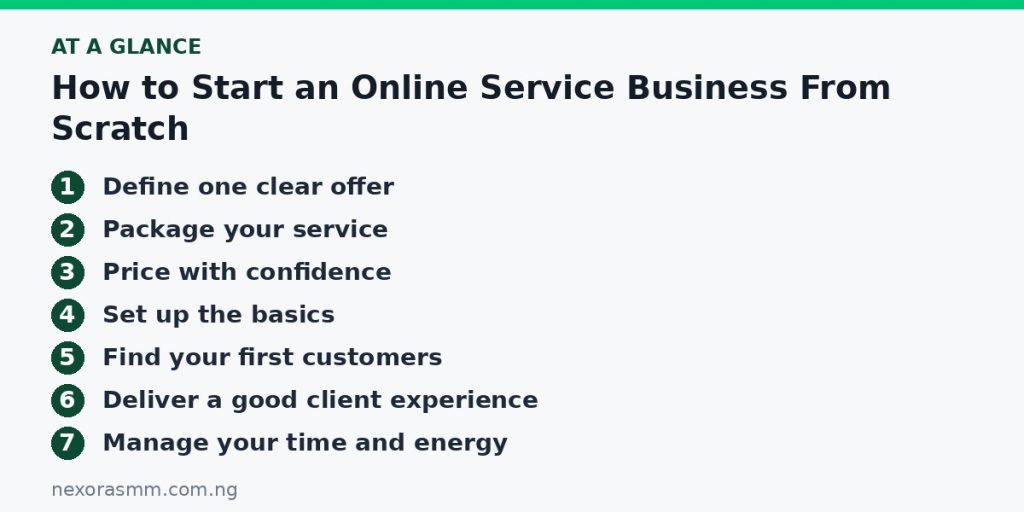
Price with confidence
Work out the minimum you need to earn per month, divide by the hours you can realistically work, and use that as a floor. Then think about the value to the customer. A service that brings a client new customers or saves them hours each week can justify a higher price than one that only fills time. Avoid competing on being the cheapest; the cheapest option often attracts the hardest clients.
Set up the basics
- A simple page: one page describing your offer, a few samples and how to contact you is enough.
- A professional email address and a consistent name across your profiles.
- A contract template: a short document stating scope, price, payment dates and ownership of the final work.
- A payment method that is safe and traceable, so both sides have a record.
Find your first customers
Start with warm contacts: friends, former colleagues and community groups. Tell them exactly what you offer and ask who they know that needs it. Then add cold outreach to businesses you have studied, with a short message offering one specific improvement. Consistency matters more than volume: contacting five suitable businesses a day for a month beats a single burst of fifty messages.
Join online communities where your clients gather, and be useful. Answer questions without selling, and let people click your profile if they want to know more.
Deliver a good client experience
Clients remember how working with you felt. A smooth process includes:
- A short onboarding form that collects everything you need.
- A clear timeline and regular updates.
- Delivery on or before the promised date.
- A polite follow-up a week later asking if everything is working and whether they need more help.
Manage your time and energy
Because you earn by the hour at first, be strict about your schedule. Block out working hours, track how long tasks really take and adjust your prices if you are consistently running over. Reserve a weekly hour for marketing, even when you are busy; otherwise your pipeline dries up the moment your projects end.
Grow beyond trading hours for money
Once you have a steady flow of clients, consider ways to scale: raise your prices, specialise further, create a repeatable process that a helper can follow, or turn your most common advice into a template or short course. Growth is easier when your service is well-defined and documented.
Warning signs to avoid
- Clients who refuse a written agreement or a deposit.
- Requests for large amounts of free work “as a test.”
- Anyone who asks you to pay a fee to start the job or to send your bank login details.
Frequently asked questions
Do I need to register a business? It depends on where you live and how much you earn. Many people begin as sole traders, but you should check local rules about registration and tax so you are not surprised later.
How many clients do I need to make a living? That depends on your prices and your costs. Work out your monthly target, divide it by your package price and you will see the number. A few long-term clients are often more stable than many one-off jobs.
Should I specialise or serve everyone? Specialising makes marketing easier. When you serve a clear group, such as dentists, schools or online shops, your examples and testimonials speak directly to the next client in that group.
How do I handle a difficult client? Refer back to your written scope. Be polite and calm, explain what is included, and offer paid options for extra requests. If the relationship stays harmful, end the contract professionally.
What tools do I need? Start simple: a document editor, a spreadsheet for invoices and a calendar. Add paid tools only when you have a clear need and the income to support them.
How can I get testimonials? Ask at the end of each successful project, while the result is fresh. Make it easy by suggesting three short questions the client can answer in a few lines.
Key takeaways
Define one clear offer, package it, price it by value and find your first clients through people you know. Keep records, use written agreements and ask for referrals. A small, well-run service can grow into a stable business without a large investment.
Educational content only — not financial advice. Income and savings results vary and are never guaranteed. How we write
Enjoyed this story?
Get the best stories delivered weekly.