How to Spot Online Investment Scams Before You Lose Money
The internet has made investing easier, but it has also made fraud easier. Every year, people lose savings to schemes that promise quick, risk-free profits: “double your money in a week,” “crypto trading with guaranteed returns,” “invest now and withdraw daily.” Behind the attractive screenshots there is often a simple fraud that pays early members with money from new ones until it collapses. This article explains how these schemes work, how to recognise warning signs and what to do before you hand over any money.
How Ponzi and pyramid schemes work
In a Ponzi scheme, the organisers promise high returns and pay early investors using deposits from newer investors. There is no real business producing the profit. A pyramid scheme rewards people mainly for recruiting others, and most participants lose money. Both depend on a constant flow of new victims. When recruitment slows, withdrawals stop and the organisers vanish.
Warning signs
- Guaranteed or unusually high returns. Real investments carry risk. A promise of steady, large profits with no risk is a major warning.
- Pressure to hurry. “Only five slots left” and “offer ends tonight” are tools to stop you thinking.
- Unclear explanation. If nobody can explain simply how the money is made, be suspicious.
- Payment for recruiting. If you earn mainly by bringing in others, it is likely a pyramid scheme.
- No registration. The company or adviser is not listed with the financial regulator in your country.
- Hard-to-trace payments. Requests to send money to personal accounts, gift cards or unknown crypto wallets.
- Small early payouts. Fraudsters often pay a little at first to build trust and encourage a bigger deposit.
- Celebrity endorsements. Fake adverts often use images and videos of famous people without permission.
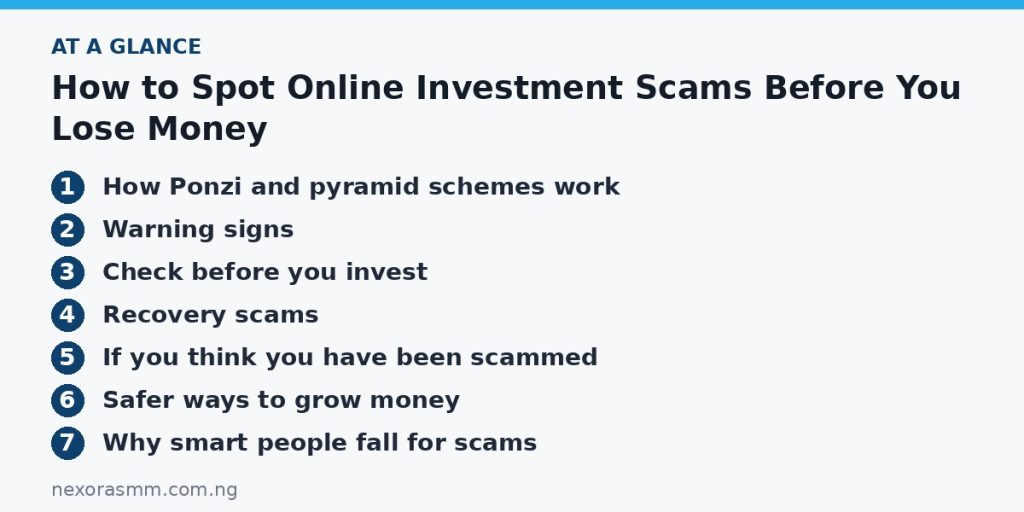
Check before you invest
- Verify the regulator. Look up the company or adviser on the official register of your country’s financial regulator. Use the regulator’s own website, not a link sent by the seller.
- Search independently. Search the name with words such as “scam,” “complaints” and “warning.”
- Ask for documents. A genuine provider can show registration details, risk statements and clear terms.
- Understand the product. If you cannot explain in a sentence how you will make money, do not invest.
- Test withdrawals cautiously. Remember that fraudsters may allow small withdrawals to build trust.
- Take your time. Wait at least a day and talk to someone you trust.
Recovery scams
People who have already lost money are often contacted by “recovery agents” who promise to get it back for an upfront fee. These are usually the same criminals or copycats. Do not pay anyone who contacts you offering to recover funds. Use official channels instead.
If you think you have been scammed
- Stop sending money immediately.
- Contact your bank or payment provider to report the transactions and ask what they can do.
- Save screenshots, receipts, messages and account details.
- Report the scheme to the police or relevant financial authority and to the platform where you saw it.
- Change passwords and secure your accounts, especially if you shared personal details.
- Warn friends and family, who may also be targets.
Scams are carefully designed to fool intelligent people. Reporting is not a sign of weakness; it helps authorities and protects others.
Safer ways to grow money
If you want to invest, start by clearing expensive debt and building an emergency fund. Then learn the basics, such as diversification, fees and time horizons, from regulated, independent sources. Be cautious with anything you do not understand, and avoid putting all your savings in one place. For personal advice, consult a licensed professional, because this article is general education and not financial advice.
Why smart people fall for scams
Fraud works by exploiting normal human feelings: the wish to improve life quickly, fear of missing out and trust in friends. Scammers build relationships over days or weeks, sometimes pretending to offer friendship or romance before introducing an investment. They may share fake screenshots of profits and claim to be successful traders. Understanding that these tactics target emotions rather than intelligence helps you stay alert and reduces any shame about asking for help.
Protect your information too
Never share one-time codes, passwords or remote access to your phone or computer with anyone offering investment help. Use strong, unique passwords and turn on two-factor authentication for your financial accounts. If someone unexpectedly contacts you about an investment through social media, messaging apps or phone calls, treat it with caution and verify who they are through an official channel.
Frequently asked questions
Is all crypto a scam? No, but many scams use crypto because transfers are hard to reverse. Treat any promised guaranteed return as a red flag, and understand the risks, including heavy price swings.
What if the platform shows profits on screen? Numbers on a website do not prove that real money exists. Fake dashboards are common.
Can a friend’s recommendation be trusted? Friends are often victims. Check the offer independently.
How can I teach my family? Share the warning signs, agree to discuss any investment before paying, and encourage them to verify the regulator.
Key takeaways
No honest investment guarantees large profits without risk. Verify registration, understand where the money comes from, resist pressure and talk to someone you trust. If something goes wrong, report it quickly. Patience is your best protection.
Educational content only — not financial advice. Income and savings results vary and are never guaranteed. How we write
Enjoyed this story?
Get the best stories delivered weekly.