How to Find Legitimate Work-From-Home Jobs (and Avoid Fake Ones)
Working from home sounds ideal: no commute, flexible hours and a wider choice of employers. It is also a favourite hiding place for scammers, because people who are searching for income are easy to target. This guide explains what real work-from-home jobs look like, where to find them and how to tell a genuine offer from a trap before you lose time or money.
Types of genuine remote work
Real remote work usually falls into a few groups:
- Customer support: answering emails, chats or calls for a company.
- Administrative and virtual assistance: scheduling, data entry, inbox management and research.
- Writing and editing: blog posts, product descriptions, proofreading and transcription.
- Design and media: graphics, video editing, social media content.
- Technical roles: web development, IT support, quality testing and data work.
- Teaching and tutoring: language lessons, school subjects and skills coaching.
- Sales and marketing: lead generation, email campaigns and community management.
Most of these ask for a skill you can demonstrate, not a payment from you.
Where to look
Dedicated remote job boards list roles that are remote by design. Company career pages are the safest source: if you like a company, check its own website for open positions. Professional networking sites let you filter for remote roles and check who is hiring. Freelance marketplaces suit short projects. Finally, ask people in your network, because many positions are filled through recommendations.
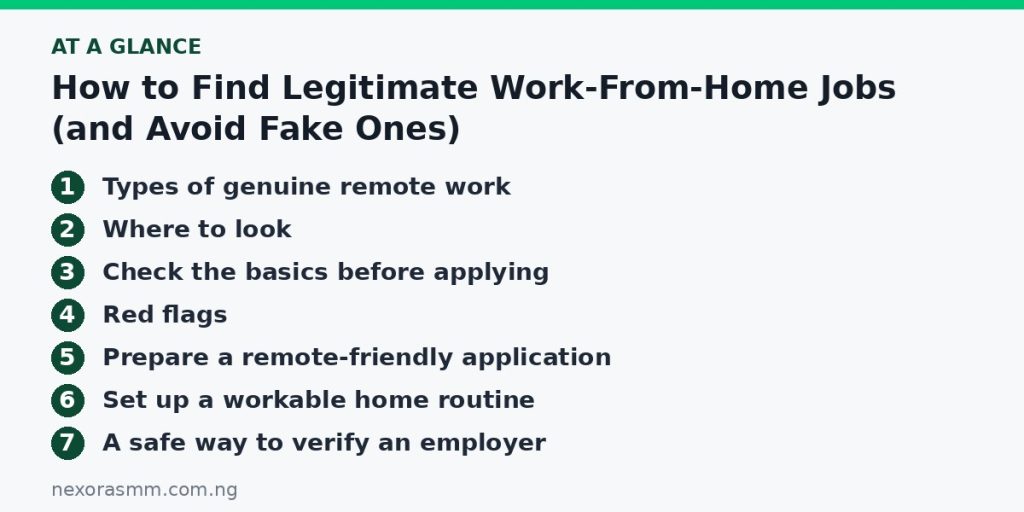
Check the basics before applying
- Does the company exist? Look for a real website, a physical or registered address and employees you can find independently.
- Is the contact genuine? Official recruiters use a company email address, not a free personal address.
- Is the job described clearly? Real listings explain duties, requirements and pay range.
- Is the process normal? Genuine hiring includes an application, usually an interview and sometimes a skills test.
Red flags
- You are asked to pay for training, equipment, a “registration fee” or a background check before starting.
- The employer sends you a cheque and asks you to forward part of it.
- The pay is unrealistically high for easy work.
- You are hired instantly with no interview.
- The conversation moves quickly to a private messaging app.
- You are asked for a bank login, identity documents or passwords early in the process.
- Your “job” is to receive and resend packages or move money through your own account.
Any one of these is a reason to stop and investigate.
Prepare a remote-friendly application
Employers hiring remotely look for proof that you can work independently. Show reliability and communication: a clear CV, a short cover message tailored to the job, samples of your work and examples of tasks you completed without supervision. Mention your internet access, working hours and any tools you already use, such as shared documents or video meetings.
Set up a workable home routine
- Choose a regular workspace, even a small corner.
- Keep fixed working hours and tell your household.
- Make sure you have a backup plan for power and internet interruptions.
- Use secure passwords and keep work files separate from personal ones.
A safe way to verify an employer
Take ten minutes before you reply to any offer. Search the company name with words like “reviews,” “scam” or “complaints.” Look for the company on professional networking sites and check whether the people who claim to work there actually appear. If a recruiter contacts you first, find the company’s official website yourself and use the contact details listed there to confirm the job exists. Ask for the offer in writing, including the job title, pay, working hours and who you report to. A genuine employer will not mind answering these questions, while a scammer will usually become vague or pressure you to hurry.
Skills that help you get hired
Clear written communication, basic computer skills, time management and the ability to solve small problems without constant help are valued in nearly every remote role. You can practise them at no cost: write clear emails, learn to use shared documents and spreadsheets and complete a free online course in a skill that interests you. Add each completed project to a simple portfolio or CV so employers can see real evidence.
Frequently asked questions
Do I need experience? Some roles need none, but you still need to show a skill or the ability to learn quickly. Short courses, volunteer work and personal projects can all count as proof.
Are paid surveys real jobs? They exist, but the pay is usually very low and they are not a reliable income.
Can I work for employers in other countries? Often yes, but check payment methods, tax obligations and whether the company hires from your country.
How do I get paid safely? Agree on the payment method and schedule in writing. Use established platforms or bank transfers, and keep records of invoices and payments.
Should I accept unpaid trial work? A short, clearly limited test is reasonable. A long unpaid “trial” that produces real work for the company is not.
Key takeaways
Real remote jobs ask for skills, not fees. Verify the company, expect a normal hiring process and treat early requests for money or personal banking details as a stop sign. Build proof of your abilities and apply steadily; the right opportunity rewards patience and careful checking.
Educational content only — not financial advice. Income and savings results vary and are never guaranteed. How we write
Enjoyed this story?
Get the best stories delivered weekly.