Google AI Overviews and Your Website Traffic: What the 2026 Studies Show
Last checked: 10 October 2026. The studies below measure click behaviour in specific conditions; they do not predict the traffic of any single site. Google disputes some of the findings.
If you are building a website to earn from advertising, one fact should shape your plan: more searchers now see an AI-written summary at the top of Google, and several studies suggest fewer of them click through to websites. This article explains what the best evidence says, where the evidence is limited and what a new website can do about it. It is not a reason to give up. It is a reason to build a site that does not depend on a single source of visitors.
The strongest evidence: a randomized experiment
A study by researchers Saharsh Agarwal and Ananya Sen, published on SSRN on 3 April 2026, randomly assigned 1,000 real users to search either with or without Google’s AI Overviews, using a browser extension. According to coverage of the paper, AI Overviews reduced outbound organic clicks by 39.8% and raised zero-click searches by 34.5%. Sponsored clicks did not move. The authors suggested the effect of AI Mode, Google’s more conversational search experience, might be even larger. One summary also noted that the clicks lost to overviews were not lower in quality than the clicks that remained, which challenges the idea that only low-value visits disappear.
Other measurements
- Pew Research: a study tracking about 900 users found clicks on a website link fell from roughly 15% of searches to 8% when an AI summary appeared. Google called the methodology flawed and said it has not seen significant drops in aggregate web traffic.
- AI Mode experiment: an August 2026 preprint with about 1,100 US users reported that forcing searches into AI Mode reduced publisher click-through by 18.8 percentage points compared with current Search. Coverage of the paper stresses that it was a short test of an early interface that showed no ads, so it is not a forecast for every site.
- Chartbeat via the Reuters Institute: Google organic search traffic to more than 2,500 news sites fell by a third globally between November 2024 and November 2025, and by 38% in the United States. News sites are not the same as new blogs, but they show the direction.
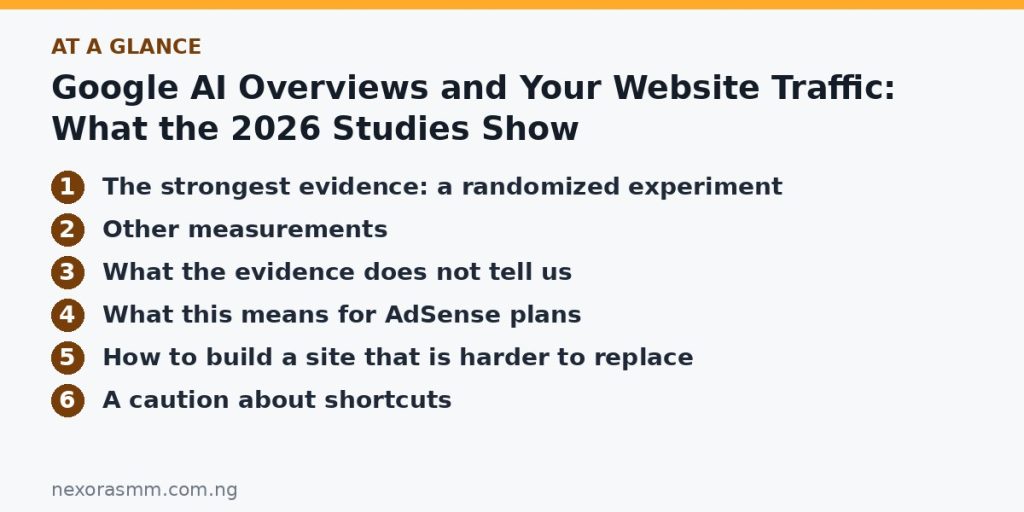
What the evidence does not tell us
None of these studies measures publisher revenue, and none tells you what will happen to a brand-new website in Nigeria. Impact varies by topic: summaries are most likely to replace clicks for simple questions with short answers, such as definitions, recipes or quick how-to steps. Pages that contain tools, original data, local knowledge or personal experience are harder to summarise away. Google also says AI features send people to a wide variety of sites, so the debate is far from settled.
What this means for AdSense plans
Display advertising depends on page views. If a larger share of searches ends without a click, the traffic needed to earn a meaningful amount rises. That does not make ad income impossible, but it argues against making ads your only plan. It also reinforces the earlier point about originality: content that a summary can fully replace is the content most exposed to this change.
How to build a site that is harder to replace
- Answer questions that need more than a paragraph. Step-by-step processes with screenshots, comparisons with real numbers and checklists are more useful on a page than in a summary.
- Add what a summary cannot copy. Local prices you verified, your own test results, interviews, templates and calculators.
- Be specific to a place and a time. A guide to Nigeria’s 2026 tax rules, with a “last checked” date, is more valuable than a generic guide about taxes.
- Build direct channels. Collect email subscribers and build a following so some visitors come without search.
- Diversify income. Services, products and sponsorships do not depend on search clicks in the same way.
- Make it easy to be cited. Clear headings, concise definitions and named sources help both readers and search features understand your page.
- Track impressions as well as clicks. In Search Console, rising impressions with flat clicks may signal that your content is being shown but summarised.
A caution about shortcuts
When traffic gets harder to win, some site owners publish large numbers of near-identical pages. That tends to make a site more replaceable, not less. A smaller number of pages with distinctive information is a safer bet.
What we could not confirm
- How AI Overviews affect small new sites specifically. Most studies cover news publishers or general search behaviour.
- Whether Google’s May 2026 changes to how AI Overviews cite sources have changed click behaviour.
- How the effect differs for searches made in Nigeria or in languages other than English.
Frequently asked questions
Is blogging dead? The evidence points to fewer clicks for some kinds of content, not the end of websites. Distinctive, useful and trusted sites still attract readers.
Should I stop targeting search? No. Search remains a major source of visitors, but it should not be your only one.
Do AI summaries use my content? They can cite or draw on web pages. Google says it directs many clicks to sites, while publishers say the net effect is negative. Check your own Search Console data.
Key takeaways
Independent studies consistently found fewer website clicks when AI summaries appear, though the size of the effect is debated. For a new site, the response is to publish things that cannot be summarised in one paragraph, build direct audiences and avoid relying on ads alone.
Sources checked
- Coverage of Agarwal and Sen, “The Impact of Google AI Overviews on Publisher Traffic and User Experience” (SSRN, April 2026)
- Search Engine Journal, coverage of the August 2026 AI Mode click-through preprint
- Search Engine Journal, “Google AI Overviews Impact on Publishers and How to Adapt Into 2026”
- Implicator, coverage of the Pew Research Center study
- Reporting on Chartbeat and Reuters Institute data on Google search referrals to news sites
Educational content only — not financial advice. Income and savings results vary and are never guaranteed. How we write
Enjoyed this story?
Get the best stories delivered weekly.