How to Make Money Online in Nigeria With No Starting Capital
Last checked: 11 October 2026. This guide summarises published Nigerian and international guides on online income. I did not find reliable income data for beginners, so no earnings figures are given. Rules, fees and platform availability change, so confirm details on each platform before you start.
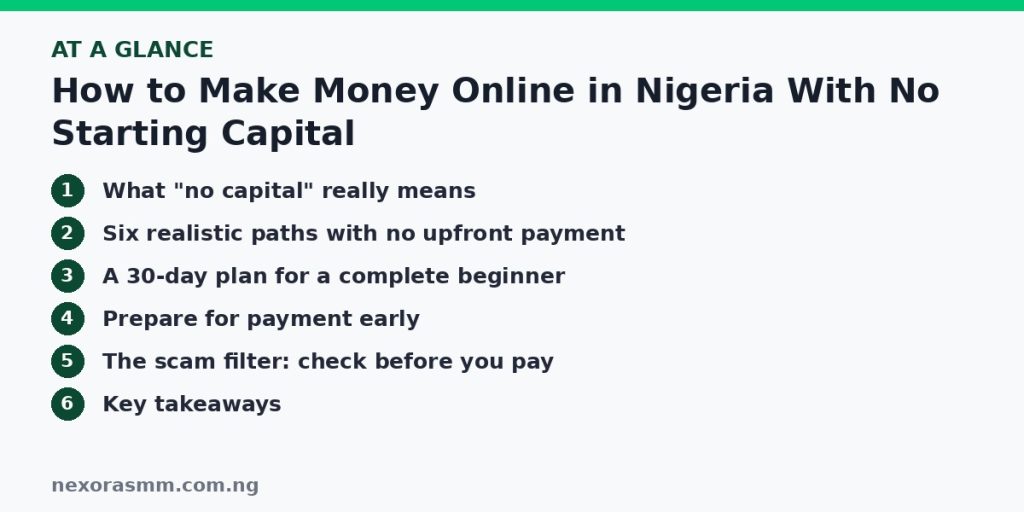
Almost every Nigerian who searches for online income has the same starting point: a phone, some data and no money to spare. The good news is that several kinds of online work cost nothing to start. The bad news is that the same search results are full of schemes that take your money first. This guide explains what “no capital” really means, which paths are realistic, how to plan your first 30 days and how to filter out scams before they cost you anything.
What “no capital” really means
You may not need to pay for a course, a licence or a starter pack, but you still spend time and data, and you may need a phone or laptop that works. One 2026 guide puts the idea plainly: with freelancing, your skills are your capital. That is the key shift. Instead of looking for a platform that pays you, look for a skill that a person or business will pay for, then use free tools to deliver it.
Six realistic paths that need no upfront payment
1. Freelance services
Writing, graphic design, video editing, web work and data tasks are named by Nigerian guides as the most common ways beginners start. Clients are found on freelance platforms such as Upwork and Fiverr, in Facebook and LinkedIn groups and through referrals. You do not pay to offer a service, though some platforms charge a fee on your earnings once you are paid.
2. Virtual assistant and social media management
A virtual assistant helps a business owner with replies to messages, scheduling posts, simple writing and organising work. One guide notes that many of these jobs come from referrals, Facebook groups and LinkedIn instead of big platforms, and that being organised and good at communication matters more than technical skill. Small local businesses that post on Instagram or WhatsApp often need this help.
3. Social selling and reselling
Nigerian guides describe WhatsApp and Instagram selling as a starting point that needs no certificate. A simple version is to list products from a supplier, take orders and deliver, so that the customer pays you before you pay the supplier. Check that a supplier is real and agree on delivery and returns before you promote anything.
4. Affiliate marketing
Affiliate marketing means earning a commission when someone buys through your link. It costs nothing to join most programmes, but it needs an audience that trusts you, so it often pays slowly at first. Be honest about links you earn from, and do not promote anything you have not checked.
5. Online tutoring
Teaching a subject or a language online is listed by Nigerian work-from-home guides as a legitimate option. If you are good at a school subject, a language or a skill, you can start with students you already know.
6. Content creation
YouTube, Facebook and blogging can pay, but they are the slowest route because you must build an audience first. Treat them as a long-term project alongside a service that pays sooner. Our guides on YouTube monetization requirements, Facebook content monetization and Google AdSense explain the rules.
A 30-day plan for a complete beginner
- Days 1 to 3: choose one skill. Pick something you can already do reasonably well, or can learn from free training. Free courses are offered by Google Skillshop and HubSpot Academy for digital marketing, according to one Nigerian guide.
- Days 4 to 10: make three samples. For example, three social media posts, a short article or a one-minute edited video. Free tools can help, as in our guide to free AI tools.
- Days 11 to 15: set up a simple profile. A clear headline, your samples and one contact method.
- Days 16 to 25: reach out. Contact local businesses, church and school groups and people you know, and apply to a small number of suitable jobs. Quality matters more than sending hundreds of messages.
- Days 26 to 30: deliver and learn. Do the first job carefully, ask for feedback and a testimonial and set a price for the next one.
Prepare for payment early
If you plan to work with foreign clients, one guide advises setting up Payoneer and one virtual dollar account before your first job. Read our guide on receiving international payments before you choose. Keep records of every payment, because Nigeria’s 2026 tax rules mean freelance income is increasingly reported; see our article on the 2026 tax rules for freelancers.
The scam filter: check before you pay or share anything
Nigerian guides repeatedly warn that fake recruitment and “task earning” offers are among the biggest risks. Treat these as warning signs:
- You are asked to pay a registration, training or “activation” fee to get work.
- Income comes mainly from recruiting other people instead of from selling something real. One guide says that if money comes from recruitment or “daily guaranteed income”, it is usually a scam.
- Someone sells “signals” or promises fixed daily profits.
- A Telegram or WhatsApp group asks you to deposit crypto or money before you can start a task.
- A “client” overpays and asks you to send back the difference.
If an offer involves investing, check the company with the Securities and Exchange Commission first. Our guide on checking SEC registration explains how.
What we could not confirm
- How much a beginner can earn. Guides give no reliable figures, so I give none.
- Which platforms accept every new Nigerian freelancer. Approval rules vary and can change.
- Whether the free training programmes named are still free and open to Nigerian learners, which you should confirm on their pages.
Frequently asked questions
Can I really start with nothing? Yes, with services you can deliver using a phone or laptop you already have, but expect to spend time and data before the first payment.
Which path pays fastest? Services for local businesses and freelance work usually pay sooner than content creation, which needs an audience first.
Is it safe to pay for a course? Many free options exist. If you do pay, check reviews from independent sources and avoid anyone who promises guaranteed income.
Key takeaways
Pick one skill, make samples, reach real clients and prepare how you will get paid. Treat any offer that asks for money first, pays for recruitment or promises daily profits as a scam until proven otherwise. Slow, honest progress with a real service beats a quick scheme.
Sources checked
- TheCondia, “How To Make Money Online in Nigeria (2026 Guide)” (updated July 2026)
- VTpass, “How to make money online in Nigeria” (2026)
- Lilach Bullock, “How to Make Money Online in Nigeria: 15 Real Ways Ranked by How Fast They Pay (2026)”
- Brands.ng, “Work From Home Jobs in Nigeria: Legit Options That Actually Pay (2026 Guide)” (May 2026)
- Brands.ng, “Is Online Business in Nigeria Legit or a Scam? Full Analysis (2026)”
- Brands.ng, “How People Really Make Money Online in Nigeria (Truth vs Hype)” (April 2026)
Educational content only — not financial advice. Income and savings results vary and are never guaranteed. How we write
Enjoyed this story?
Get the best stories delivered weekly.