Best Legitimate Ways Freelancers Can Receive International Payments
Last checked: 11 October 2026. Many comparison pages online are written by payment companies, so I treated provider claims with care and say where a source has an interest. Fees, limits and availability for Nigerian users change often. Verify everything on the provider’s own current page and inside its app before you rely on it.
Getting a foreign client is half the job. The other half is receiving the money safely, through a route that is legal, traceable and affordable. For freelancers in Nigeria, that question has become more complicated, because a payment method that worked last year may be limited today, and the internet is full of “payment officers” and “verification agents” who exist only to take your money. This guide does not name one winner. It explains the main legitimate routes, what each one is good for, the limits reported in 2026 and the tests that tell a genuine provider from a risky one. For a method to compare real costs, see our earlier guide on choosing a way to get paid from abroad.
What “legitimate” should mean
Before you compare fees, check these basics for any provider or route:
- It asks for proper identity verification. Genuine providers ask for ID and sometimes proof of address. A service that skips verification entirely is a warning sign.
- Its fees are written down. You should be able to find receiving fees, conversion margins and withdrawal costs on its own pages.
- It never charges an “activation” or “verification” fee through a third party. Fees are shown inside the app or on the official site, not requested by a stranger on WhatsApp.
- It has a trace. Payments should appear on statements with references you can show to a client, a bank or the tax office.
- It works with your client’s side. If a platform pays only to certain providers, check that list first.
Also check the provider’s regulatory status on the official site of the regulator in its home country and on Nigerian regulators’ public lists where relevant. I did not verify any specific provider’s licence for this article, so do that check yourself.
Route 1: A payout platform with foreign receiving details (Payoneer)
Payoneer is the most commonly named option in Nigerian guides, mainly because it works with marketplaces such as Upwork and Fiverr and issues receiving details that clients can use. A 2026 guide reports that withdrawing to a Nigerian bank in naira typically costs around 2 percent, and quotes a review putting conversion costs anywhere from about 2 percent to 4.5 percent depending on route and account type. That guide is published by a competitor, so confirm the current numbers on Payoneer’s fee page.
Route 2: Nigerian fintech apps that give you a virtual dollar account
Several Nigerian-focused apps, including Grey, Raenest and Cleva, offer virtual foreign accounts so clients can pay in dollars, pounds or euros and you can convert and withdraw to a Nigerian bank. Business reporting in 2025 said Grey had nearly two million users. These apps are popular because opening one is usually faster than opening a bank account, and many freelancers combine one with Payoneer, using Payoneer for marketplace work and the app for direct client payments. The risks: each company sets its own limits and checks, accounts can be paused for verification, and many “best” lists come from the companies themselves. Test with a small amount first.
Route 3: A domiciliary account at a Nigerian bank
A domiciliary account is a foreign-currency account at a Nigerian bank, usually in dollars, pounds or euros. A 2026 guide says the Central Bank of Nigeria has confirmed it will not force holders to convert foreign currency to naira, so balances can be kept, traded or converted at the holder’s discretion. A client can send an international wire to the account, which gives you a clear paper trail that banks and tax officers understand. The trade-offs are paperwork, possible delays and, as one provider’s blog notes, that cards linked to such accounts are sometimes unreliable for international online payments. Ask your bank about incoming wire fees and any intermediary bank charges before you give the details to a client.
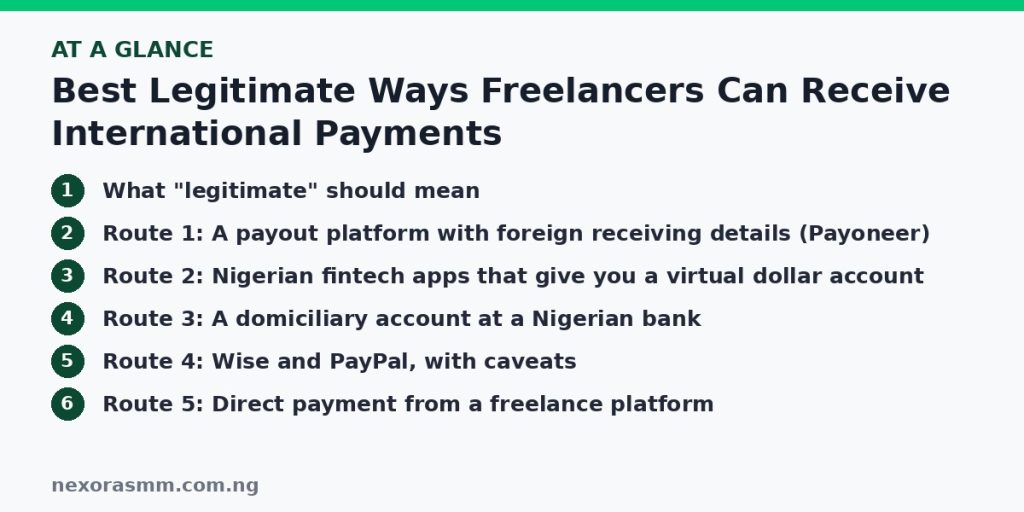
Route 4: Wise and PayPal, with caveats
Wise and PayPal are familiar to many foreign clients, but their rules for Nigerian residents are not the same as for senders. Wise’s own pages say a person with a Wise account abroad can send naira to a Nigerian bank account, and the recipient does not need a Wise account. That is a legitimate way for a foreign client to pay you. However, a 2026 guide summarising Wise’s help documentation says Nigerian residents currently cannot open Wise account details or hold balances, and another provider says Wise suspended USD transfers to Nigeria in 2022. Some older guides still list Wise as a receiving account for Nigerians, so check your own options inside the app before you promise a client anything. For PayPal, sources describe restrictions on receiving and withdrawing from Nigeria, so confirm what your account can do.
Route 5: Direct payment from a freelance platform
Platforms such as Upwork and Fiverr have their own payout options, which can change. Before you accept your first job, open the platform’s payment settings and see which methods are offered for your country. This avoids opening several accounts you cannot use.
A note on crypto and stablecoins
Some apps promote receiving payment in stablecoins. This can add price, platform and regulatory risks, and Nigerian regulators have repeatedly warned about unregistered crypto platforms, including a June warning about the CBEX platform and unauthorised crypto assets reported by TheCable. If a client offers crypto, make sure you understand how you will turn it into naira, what fees apply and whether the platform is regulated, and do not rely on a stranger’s wallet link. Many beginners will be safer using a regulated bank or payout route.
Scams to avoid when you are being paid
- Overpayment. A client “accidentally” pays too much and asks you to refund the difference. The first payment may later fail.
- Pass-through requests. Someone asks you to receive money and forward it. You may be used to launder funds.
- Fake verification agents. Anyone asking for a fee to “verify” your payment account is not part of any genuine provider.
- Lookalike login pages. Type the provider’s address yourself and never share passwords or verification codes.
Keep your records
Nigeria’s tax rules changed in 2026. One guide says many freelancers will pay personal income tax formally for the first time from January 2026, following the Nigeria Tax Act 2025. Save invoices, platform statements and bank records showing the conversion to naira. Our article on the 2026 tax rules for freelancers explains what is clear and what is not.
What we could not confirm
- Current fee tables and exchange margins for any provider. They change, and comparison pages often have a commercial interest.
- Whether Wise, PayPal or any other service currently works for your specific situation as a Nigerian resident.
- One provider’s blog reports a May 2026 CBN directive on international money transfer operators using naira settlement accounts. I did not verify this and it concerns remittances, so ask your bank how it affects you.
Frequently asked questions
Which is the best option? It depends on who pays you and how often. Most freelancers use one main route and one backup.
Is it safe to give my bank details to a foreign client? Account and routing details issued for receiving payments are meant to be shared. Your password, PIN and verification codes are not.
Should I convert dollars immediately? It depends on your costs and risk. Exchange rates can move either way.
Key takeaways
A legitimate payment route has verification, written fees and a clear paper trail. Payoneer, Nigerian virtual dollar apps and domiciliary accounts are the main options named in 2026 guides, while Wise and PayPal need extra checking for Nigerian residents. Test any route with a small payment, avoid anyone who charges “verification” fees and keep records for tax.
Sources checked
- VaultLeap, “Receiving USD Payments in Nigeria: The Complete Guide (2026)” (a provider’s guide)
- TheCondia, “Top Payment Apps for Freelancers in Nigeria 2026”
- Semafor, “Nigeria-born banking startups target emerging-market gig workers” (February 2025)
- Wise, pages on sending money to Nigeria and Nigerian naira account alternatives
- Cleva, “5 Alternatives to Domiciliary Accounts in Nigeria” (a provider’s blog)
- Figo, “The Complete Guide to Freelance Payments in USD from Nigeria (2026)” (a provider’s blog)
- NairaCompare, “The Complete Personal Finance Guide for Nigerian Freelancers and Remote Workers (2026 Edition)”
- TheCable, report on SEC warnings about unregistered crypto platforms
Educational content only — not financial advice. Income and savings results vary and are never guaranteed. How we write
Enjoyed this story?
Get the best stories delivered weekly.