How to Start a Small Online Business With Limited Capital

Last checked: 10 October 2026. Prices, tax thresholds and platform rules change. The numbers in the examples are illustrations, and the tax notes describe public reporting, not personal tax advice.
Starting an online business in Nigeria with limited money is possible, but the way you spend your first ₦50,000 or ₦100,000 matters far more than how big the idea sounds. In 2026, high food and transport costs make mistakes costly, and new tax rules and fraud warnings add more to think about. This guide gives a step-by-step method: choose the lowest-risk model, test before you stock up, set prices that survive inflation, take payments safely and keep records that will help you when the business grows.
Step 1: Pick a low-risk business model
When capital is small, your biggest risk is buying stock you cannot sell. Rank these models from lowest to highest risk:
- Services: social media management, design, writing, tutoring, repairs or cleaning. You sell time and skill, so you need little stock.
- Pre-orders and made-to-order: you buy materials only after a customer pays a deposit, which suits food, tailoring and crafts.
- Digital products: templates, guides or printable resources you create once.
- Small-batch resale: you buy a small quantity of goods people already ask you for.
- Large stock purchases: the highest risk and the worst place to start.
Step 2: Test demand before spending
Describe your offer to ten people who fit your target customer and ask whether they would buy, at what price and how soon. Even better, ask for a deposit on a pre-order. One real paid order teaches more than a month of planning. If nobody will commit, change the offer, not your hopes.
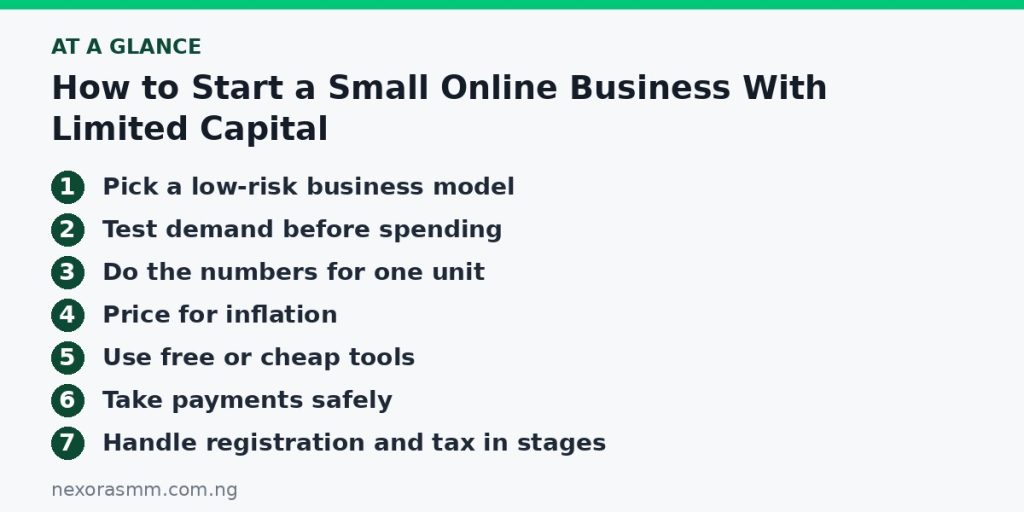
Step 3: Do the numbers for one unit
Here is an illustration. Suppose you make snack packs. Ingredients and packaging cost ₦700 per pack, delivery and data cost ₦150, and you sell each pack for ₦1,200. Your profit is ₦350 per pack, before counting your time. If you sell 60 packs in a week, you earn ₦21,000 profit. If ingredient prices rise by 20 percent, your ingredients cost ₦840 and profit falls to ₦210 unless you raise the price. This simple calculation shows why you must recalculate when prices move.
Step 4: Price for inflation
With food inflation at 19.57% year on year in August 2026, according to the National Bureau of Statistics, supplier prices may change quickly. Check your costs every week or two, keep a note of the date you last updated your prices and tell customers politely when a price changes. Ignoring this is a common way for small sellers to work hard and lose money.
Step 5: Use free or cheap tools
- A business profile on a social platform, with clear photos, prices and a way to order.
- A free business messaging app so customers can see your catalogue and you can reply with saved answers.
- A notebook or spreadsheet for orders, payments and expenses.
- A basic design app for posters and product images.
Step 6: Take payments safely
- Confirm every transfer in your own bank app before you deliver.
- Do not accept screenshots, forwarded alerts or “payment pending” messages as proof.
- For custom orders, collect a deposit first.
- Be cautious with overpayments and requests to send change to a third party.
Step 7: Handle registration and tax in stages
You can test an idea before registering, but plan for it. When you register a business name with the Corporate Affairs Commission, customers and banks take you more seriously. On tax, Nigeria’s 2026 reforms reportedly exempt small companies from company income tax, capital gains tax and the development levy. Reports describe a small company as one with turnover up to ₦100 million and fixed assets up to ₦250 million, though one part of the law was reported to say ₦50 million and experts called that an error. Businesses providing professional services are reported not to count as small, so check how your business is classified. For individuals, the first ₦800,000 of taxable annual income is reported at 0%, with higher bands above that. Keep records of sales and costs so you can prove your income and expenses.
Step 8: Avoid expensive borrowing
If you must borrow, compare the total repayment, and check that the lender is on the regulator’s register. The Federal Competition and Consumer Protection Commission said digital lenders had to register under new rules, and reported that some apps were on a watchlist. A short, high-cost loan can wipe out the profit of a small business.
Step 9: Build trust
- Show real photos of your products and process.
- Collect short reviews from happy customers with their permission.
- State delivery times honestly and update customers when something is delayed.
- Keep your promises on refunds and replacements.
A sample ₦50,000 start (illustration)
- Materials for the first batch: ₦25,000
- Packaging and labels: ₦6,000
- Data and phone use for a month: ₦5,000
- Small test advert or boost: ₦4,000
- Delivery float: ₦5,000
- Reserve for price changes: ₦5,000
Use first sales to refill materials, and move profit into a separate account so you do not accidentally spend the business’s money.
What we could not confirm
- How the small-company tax definition will apply to your business, because the law’s text and commentary differed.
- Your local costs and demand, which you must test yourself.
- Platform fees and rules, which change.
Frequently asked questions
Do I need to register before I sell? Not always to test, but registration helps with credibility, banking and bigger customers. Check your local requirements.
What is the cheapest business to start? A service based on a skill you already have usually needs the least capital.
How do I stop losing money to price changes? Recalculate your cost per unit regularly and adjust prices on a schedule.
Key takeaways
Start with services or pre-orders, test demand with real payments, calculate profit per unit and price for inflation. Use free tools, confirm payments yourself, keep records and grow in small steps. A small, careful start protects you from the mistakes that end most new businesses.
Sources checked
- Voice of Nigeria, “Nigeria’s Headline Inflation Eases to 15.39% in August – NBS”
- Baker Tilly Nigeria, “Nigeria’s 2025 Tax Reform Acts Explained”
- TheCable, “SPOTTED: Nigeria Tax Act contradicts NTAA on turnover cap for small business”
- Mercans, “Nigeria – Changes to Personal Income Tax”
- BusinessDay, report on FCCPC enforcement against unregistered loan apps
Educational content only — not financial advice. Income and savings results vary and are never guaranteed. How we write
Enjoyed this story?
Get the best stories delivered weekly.