How to Sell MT5 Indicators Online: A Beginner’s Business Guide
Last checked: 12 October 2026. This guide draws on the MetaTrader 5 Help page “How to Become a Seller”, the MQL5 Market rules as quoted by sellers, and regulator material on trading-system advertising. Fees and rules change, so confirm each figure on the provider’s own page. This is business information, not legal, tax or financial advice.
Writing a useful MT5 indicator is one skill. Selling it is another. Many developers finish a tool, upload it somewhere and wait, then wonder why nobody buys. This guide walks through the business side in the order you will meet it: what you are actually selling, who buys it, which route to market to choose, what rules apply and how to avoid the mistakes that get products removed or sellers into trouble.
What you are really selling
A trader does not buy code. A trader buys time saved or a clearer view of the chart. An indicator that draws support and resistance levels saves the hand-drawing. A risk calculator removes arithmetic errors. A scanner replaces flicking through twenty charts. When you describe your product, describe the job it does, not the programming inside it. This also keeps you on the right side of the rules, because a tool that “shows swing levels” is a statement of fact, while one that “finds winning trades” is a promise nobody can keep.
It also helps to be clear about what your product is not. An indicator is not financial advice, not a signal service and not a way to guarantee profit. Several platforms treat those categories very differently, as the next sections show.
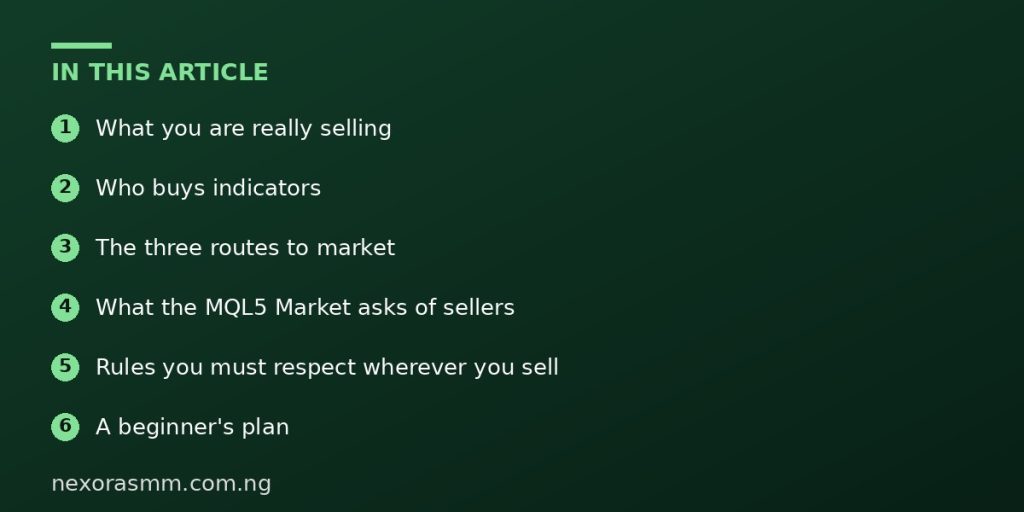
Who buys indicators
- Beginners who want a ready-made tool and are often attracted by bold promises. They are also the group most likely to ask for a refund or leave angry reviews when results disappoint.
- Intermediate traders who already have a method and want a tool that automates part of it, such as alerts, multi-pair scanning or position sizing. They tend to value clear documentation and a free trial.
- Experienced traders who buy utilities, not strategies. They care about reliability, speed and whether the tool repaints.
Utilities for the second and third groups, such as dashboards, calculators and alert tools, are easier to describe honestly than “signal” indicators, and they attract fewer disputes.
The three routes to market
- A marketplace such as the MQL5 Market. The MetaTrader 5 help explains that sellers register through an MQL5.community account, upload a product and publish it so it appears both on the website and inside the trading platform. The marketplace handles delivery, copy protection and payment, and in return it takes a commission. Details are in a later article in this series.
- Your own website. You control pricing, branding and the customer relationship, but you must handle payments, delivery, licensing and support yourself.
- A hybrid. Sell a simple version on a marketplace to find customers, and a more advanced or custom version directly.
For a first product, a marketplace usually removes the most work. A website becomes attractive when you have several products, a following and the ability to run support.
What the MQL5 Market asks of sellers
The MetaTrader 5 help page states that the minimum price for Market products is 30 USD and that the Market charges a 20 percent commission, so a product sold at 100 USD pays the seller 80 USD. Every product has at least five activations, one used at purchase and four for later use, and the seller may raise that number. Uploaded files go through automatic validation, and the rules prohibit products that contain profit promises. Another MQL5.com page says all Market products are encrypted. Older discussions quote different numbers, such as a 10 dollar minimum and two extra activations, which is a reminder that rules change. Always read the current service rules before you plan your pricing.
Rules you must respect wherever you sell
Regulators in several countries have acted against sellers of trading systems who advertise results that were not real. The US Federal Trade Commission has charged a trading software seller for using theoretical past earnings charts to sell a program, and the Commodity Futures Trading Commission has repeatedly acted against sellers who presented hypothetical results as if they were actual trading. Their message is simple: do not present simulated results as real, do not promise profit and do not downplay risk. Even if you are not in the United States, these principles are a sensible baseline, and payment providers and ad platforms apply similar logic.
A beginner’s plan
- Pick one narrow problem and build a reliable tool for it.
- Test it properly, including on a live demo account for several weeks.
- Write documentation that a beginner can follow.
- Prepare a free version or a time-limited trial so buyers can test before paying.
- Choose one route to market and read its rules in full.
- Price the product so that, after fees, the sale is still worth your time.
- Plan support and updates before you launch, not after.
Costs people forget
- The marketplace commission or payment fees on every sale.
- Your time answering support questions, which usually costs more than the software itself.
- Updates when the platform changes. Build numbers change, and old tools can break.
- Refunds, chargebacks and the lost sale that comes with them.
- Tax. Income from selling software is generally taxable. Talk to an accountant in your country.
What we could not confirm
- How much a typical new seller earns. We found no reliable published data, and be sceptical of anyone who quotes figures without evidence.
- That the Market’s commission and minimum price are unchanged. We cited the current MetaTrader 5 help page, and the live rules could differ.
Frequently asked questions
Do I need a company to start? A marketplace may only need a verified personal account. Some payment providers for your own website require business registration, which later articles discuss.
Can I sell a free indicator I found online? Only if you hold the rights. Marketplaces and payment platforms prohibit products you do not own the intellectual property rights to.
Should I sell signals instead? Signal services are regulated more strictly and are prohibited outright by some payment platforms. An indicator is a software tool, which is a very different category.
Key takeaways
Sell a clearly described tool that saves traders time, start with a marketplace, never promise profit, count every cost including support and read each platform’s rules before you build your plan around it.
Sources checked
- MetaTrader 5 Help, “How to Become a Seller”, metatrader5.com
- MQL5.com, “How Secure Is It to Buy MQL5 Market Products?”, mql5.com
- US Federal Trade Commission, settlement involving an investment trading software seller and hypothetical earnings claims, ftc.gov
- US CFTC, Fraud Advisory on commodity trading systems sold on the Internet, cftc.gov
Educational content only — not financial advice. Income and savings results vary and are never guaranteed. How we write
Enjoyed this story?
Get the best stories delivered weekly.