Is Dangote Cement a Good Stock to Buy for Beginners?

Last checked: 11 October 2026. This article weighs the factors a beginner should consider. It does not say whether you should buy. Educational information only, not investment advice. Share prices change every trading day and you can lose money. Figures come from public reports and company filings as of early October 2026, so check current data before you act.
“Is it a good stock?” is the question beginners ask most, and nobody can answer it for you. A stock that suits one person’s goals and risk tolerance can be wrong for another. What can be done honestly is to list the strengths, the weaknesses and the questions you should answer for yourself. This article does that for Dangote Cement using public information from 2026.
What works in its favour
- Scale and profit. For the first half of 2026 the company reported revenue of ₦2.51 trillion and profit after tax of ₦638.5 billion, up 22.7 percent, according to its results. Group volumes were up 11.8 percent to 14.9 million tonnes.
- Cash position. The company reported a net cash position of ₦215.2 billion at the end of June 2026, meaning cash exceeded debt.
- Dividend record. The company’s own table shows a cash dividend every year since listing, rising to ₦45 per share for 2025, a 50 percent increase on the ₦30 for 2024.
- Familiarity. Cement is a product people understand, and it is tied to housing and infrastructure demand.
What should give you pause
- It has already run. The shares rose about 75 percent in 2026 to early October. Buying after a big rally means you pay more for the same earnings, and the stock fell 10 percent in a day in June.
- Volatility. An independent report puts annualised volatility at 35.6 percent and the beta at 1.37 against the NGX All-Share Index. Expect large swings.
- Concentrated ownership. Reports say Aliko Dangote holds about 86.8 percent of the shares, and the free float is small, about 11 percent on MarketScreener’s figure. The price can react sharply to modest buying or selling.
- Sensitivity to the economy. An analyst’s report notes that earlier growth was boosted by the naira’s fall, which also caused foreign-exchange losses and higher finance costs. Energy and logistics costs matter too.
- Competition. BUA Cement reported a 79.6 percent rise in first-half profit after tax, so rivals are growing quickly.
- Weak spots. In the Pan-African business, EBITDA margin fell to 17.6 percent from 20.1 percent in H1 2026.
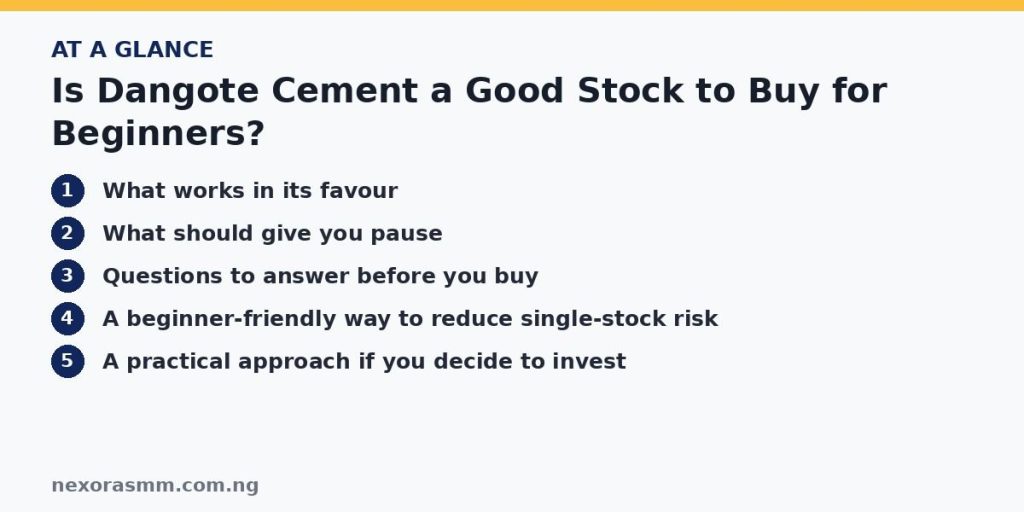
Questions to answer before you buy
- What is the money for? Money you may need within a year should not sit in a share that can fall 10 percent in a day.
- How long can you hold? Stocks are usually judged over years, not weeks.
- How much of your savings is this? Putting everything in one company is high risk. Many beginners limit any single stock to a small slice.
- Could you sit through a 30 percent drop? If not, size the position smaller.
- Do you understand the costs? Round-trip fees of about 4 percent, as one guide estimates, make frequent trading expensive.
A beginner-friendly way to reduce single-stock risk
You do not have to pick one company. The NGX also lists exchange-traded funds, including the Stanbic IBTC ETF 30 and the Vetiva Griffin 30 ETF, which hold baskets of Nigerian shares. Mutual funds are another route. They have their own fees and risks, so research them separately, and ask a registered adviser if you need personal guidance.
A practical approach if you decide to invest
- Start with a small amount you can afford to lose.
- Buy in several instalments, not all at once, to reduce the risk of buying at a peak.
- Write down why you bought and what would make you sell.
- Read the company’s results when they come out, not just the price.
- Ignore tips from social media or anyone promising certain gains.
What we could not confirm
- Whether Dangote Cement is a good investment for you. That depends on your goals, income, time horizon and risk tolerance.
- How the shares will perform. Past gains do not guarantee future returns.
- Whether the shares are cheap or expensive. Different valuation methods give different answers.
Frequently asked questions
Is it safer than a small company? Larger companies can be more stable, but this stock has still moved sharply in 2026.
Should beginners wait for a fall? Nobody can predict short-term moves reliably. Splitting purchases over time is one way to reduce timing risk.
Key takeaways
Dangote Cement has strong profits, a net cash position and a long dividend record, but it has also rallied hard, moves sharply and has concentrated ownership. A beginner should decide the purpose of the money, limit the position size and consider diversified options before buying a single stock.
Sources checked
- Dangote Cement, H1 2026 unaudited results (NGX filing, 29 July 2026)
- Daily Trust, ‘Dangote Cement grows profit by 22.7%, earns N2.51trn in 6 months’
- Dangote Cement, share information page (dividend history)
- Shore Africa, ‘Aliko Dangote gains N8.4 trillion from Dangote Cement shares’
- Olalekan Akinola, ‘Dangote Cement: Investment Report’ (September 2026)
- Guardian Nigeria, ‘Cement firms grow profit by 40% to N1.17 trillion in H1’
- EODHD, list of NGX-listed securities (ETFs)
Educational content only — not financial advice. Income and savings results vary and are never guaranteed. How we write
Enjoyed this story?
Get the best stories delivered weekly.