Best Ways to Start Investing in Nigerian Stocks With Little Money

Last checked: 13 October 2026. This is general education, not financial advice. Shares can lose value, and the examples use recent prices that change daily.
You do not need millions to begin investing in Nigerian shares. Some platforms accept ₦5,000 to open an account. The harder part is starting in a way that fees, panic and over-excitement do not wear down. These are the practical routes, in the order most beginners should think about them.
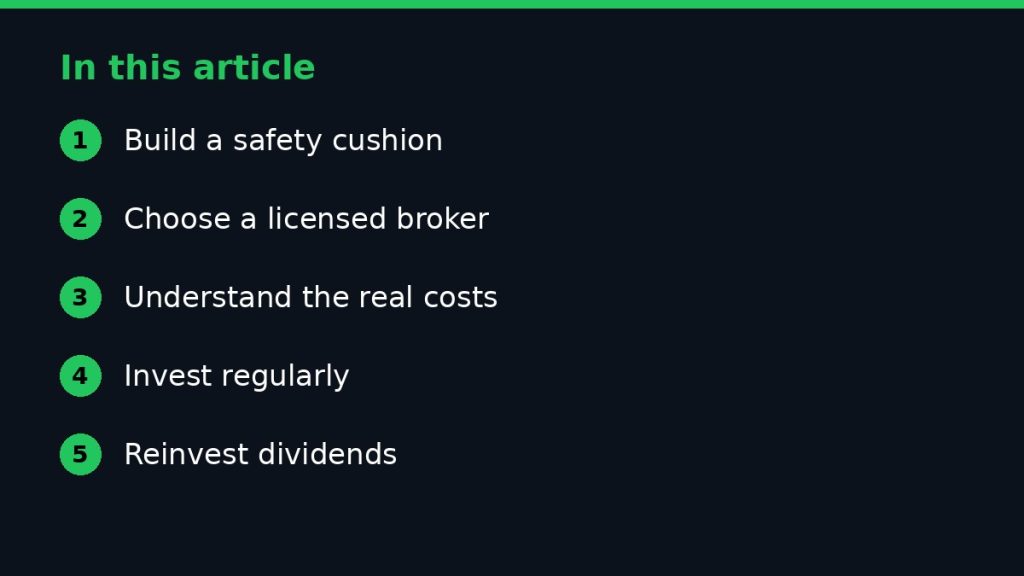
1. Build a safety cushion first
Shares can fall, and you should never be forced to sell at a bad moment. The NGX All-Share Index rose strongly in 2026 (+46.8% in the first half) but still dropped about 9% from its 13 May peak to the end of June. Keep money for emergencies in a savings account before you buy anything.
2. Choose a licensed broker or app
You buy NGX shares through a licensed stockbroker, directly or through an investment app that works with one. A 2026 broker comparison listed minimum deposits of ₦5,000 at Chaka and Bamboo, ₦20,000 at Meristem, ₦50,000 at CardinalStone, and ₦100,000 at ARM Securities and Stanbic IBTC. Commissions in that list ran from 1.2% to 1.8%. Check each firm’s current terms, and make sure it is registered with the SEC Nigeria.
3. Understand the real costs
Fees matter more on small amounts. Commission, SEC and NGX fees, stamp duty and VAT add up to roughly 1.9% to 2.5% per trade in one 2026 comparison, and another guide estimated a full buy-and-sell round trip at about 2.3% to 4.5% depending on the platform. A flat minimum commission, such as ₦100 at one app, equals 2% of a ₦5,000 purchase.
4. Start with a small, simple purchase
Begin with one or two companies you understand, such as established banks or large consumer businesses, rather than unfamiliar penny stocks. The goal of the first purchase is to learn how ordering, settlement and your account statement work. Nigeria moved to one-business-day settlement on 1 June 2026, so shares appear in your account quickly.
5. Invest regularly, not all at once
Putting in a fixed amount each month spreads your purchases across different prices. It also builds a habit. A smaller amount every month beats a big sum you cannot repeat. Avoid the temptation to time the market.
6. Add more companies over time
As your balance grows, spread across sectors such as banking, telecoms, cement, food and energy. Owning several companies reduces the harm if one disappoints. Do not add so many tiny positions that fees swallow the benefit.
7. Collect and reinvest dividends
Many large Nigerian companies pay dividends, normally after 10% withholding tax. Reinvesting them buys more shares and can speed up growth. Dividends are not guaranteed, and some bank payments were reportedly held back by the regulator in 2026.
8. Compare with safer options
At the 7 October 2026 auction, the 364-day treasury bill stop rate was 15.85%, and inflation was 15.39% in August. Shares can beat those figures but can also lose money. Many people keep some money in lower-risk instruments while investing a smaller share in stocks.
Mistakes to avoid
- Borrowing money to buy shares.
- Following hot tips or social media promises of fast profits.
- Buying because a share rose 300% last week.
- Checking prices daily and selling in a panic.
A simple first 90 days
- Month 1: build your emergency cushion, compare two or three brokers and open an account.
- Month 2: make one small purchase of a large, familiar company and watch how settlement works.
- Month 3: set a monthly amount, record the fees you paid and decide whether the platform suits you.
The aim of the first 90 days is to build a calm routine, not to chase a result.
Keep learning as you go
Read the annual report of any company you own, follow its results and note how its dividend changes. Small, steady learning reduces the chance of costly mistakes, and it makes later, larger investments feel far less stressful.
What we could not confirm
- Current minimums and fees at every broker, which change.
- Future returns on any share or on the market.
Frequently asked questions
What is the smallest amount I can start with? Some platforms advertise ₦5,000 minimums, though fees take a bigger bite from small amounts.
Can I lose all my money? A single company can fail, which is why spreading money across several companies matters.
How long should I invest? Think in years, not weeks.
Key takeaways
Save an emergency cushion, use a licensed broker, count the fees, start simple, invest regularly, spread your holdings over time and keep reinvesting only what you can afford to leave alone.
Most importantly, high dividends do not automatically mean a good investment. A company can reduce its payments, and its share price can decline.
The goal is to build a sustainable investment strategy, not chase quick profits. By reinvesting thoughtfully, managing costs, diversifying, and reviewing investments regularly, investors can give their money an opportunity to work toward long-term financial growth.
Sources checked
- Kobo Terminal, stockbrokers in 2026 comparison
- NairaCompare, beginner’s guide to buying shares and the cost of trading stocks in Nigeria
- Nairametrics, H1 2026 NGX report, 4 July 2026
- Nairametrics, treasury bill auction report, 7 October 2026
- Nairametrics, headline inflation for August 2026
Educational content only — not financial advice. Income and savings results vary and are never guaranteed. How we write
Enjoyed this story?
Get the best stories delivered weekly.