How to Build a Stock Portfolio on a Small Salary
Last checked: 13 October 2026. This is general guidance with illustrative numbers, not financial advice. Your own situation, risk tolerance and tax position will differ.
A small salary leaves little room, so every naira you invest has to be chosen with care. The good news is that investing is mostly about consistency. A modest amount, added regularly for years, can build a real portfolio.
Step 1: Cover the basics first
Pay for food, rent, transport and any urgent debts. Then build a small emergency fund so you are not forced to sell shares when something goes wrong. Shares can drop in value: the NGX All-Share Index fell about 9% between 13 May and 30 June 2026, despite rising 46.8% in the first half.
Step 2: Choose an amount you can keep up
Pick a figure that will not strain you. A common rule of thumb is to invest a fixed percentage of income. On a ₦150,000 monthly salary, 5% is ₦7,500 and 10% is ₦15,000. This is only an example. The right amount depends on your expenses, and an amount you can sustain is better than a large amount you stop after two months.
Step 3: Automate the habit
Set aside the money on payday, before you spend it. Some people move it into a separate account and invest when it reaches a threshold such as ₦20,000, to reduce the share lost to fixed fees. One app charges a ₦100 minimum commission, which is 2% on a ₦5,000 purchase and 0.5% on ₦20,000, so batching makes sense.
Step 4: Keep costs low
Compare brokers and apps. A 2026 comparison listed commissions between 1.2% and 1.8% with minimum deposits from ₦5,000, and total per-trade costs near 1.9% to 2.5%. Another guide put a round trip at about 2.3% on a low-cost app compared with 4% to 4.5% at a traditional broker. Over many years, that difference compounds.
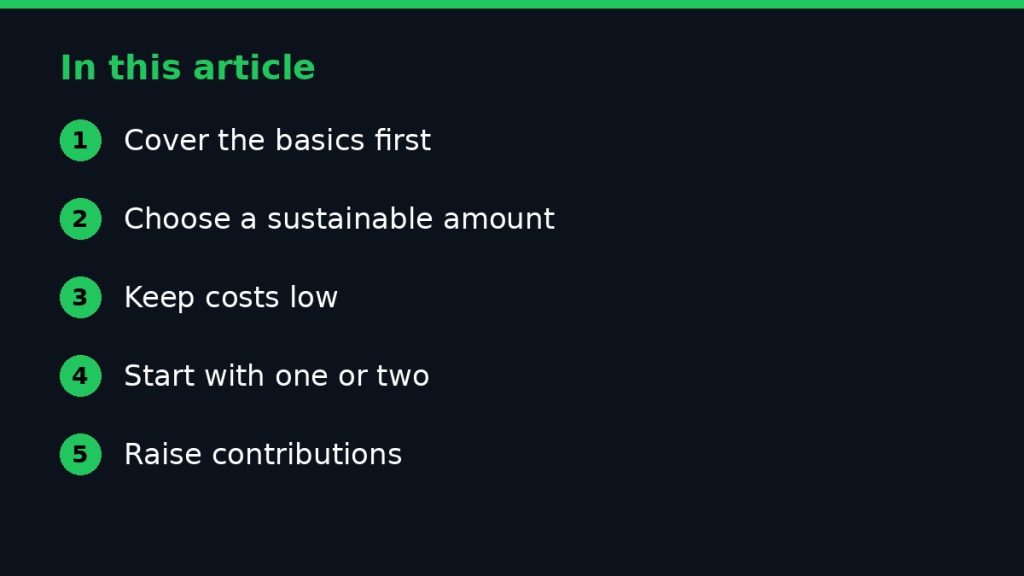
Step 5: Start with one or two holdings
Begin with well-known companies that have a record of profit and dividends, such as established banks, then add other sectors as your balance grows. For example, your first ₦20,000 might go into one bank, your next ₦20,000 into a telecoms or consumer company. Avoid spreading ₦7,500 across five shares.
Step 6: Reinvest dividends
Companies like GTCO and Zenith Bank paid dividends in the region of 8% to 10% of their recent share prices in the latest year, before 10% tax. Dividends can fund extra purchases without new money, but they are not guaranteed and may be delayed by regulation, as some bank payments reportedly were in 2026.
Step 7: Raise contributions with your income
When you get a raise, send part of it to investing before your spending rises to match. Even a small percentage increase makes a difference over five years. For example, ₦20,000 a month at an average 10% yearly return would grow to about ₦1.54 million in five years, while ₦30,000 would reach about ₦2.3 million. These are illustrations, not predictions.
Step 8: Do not borrow to invest
Loans cost money and shares can fall. Borrowing to buy shares can leave you owing more than your investments are worth. With inflation at 15.39% in August 2026, interest costs can also be heavy.
Step 9: Mix in lower-risk savings
Keep part of your savings in lower-risk places. The 364-day treasury bill stop rate was 15.85% at the 7 October 2026 auction. Choose a balance of shares and safer savings that lets you sleep at night.
Step 10: Review twice a year
Check your holdings, dividends and costs. Ask whether your plan still fits your income, and adjust it. Do not react to every price move.
When a small salary changes
If your income drops or an emergency arrives, pause new purchases first. Selling shares should be a last step, because fees and a low price can lock in a loss. Having a written plan for these moments keeps the portfolio intact through difficult months.
Keep it simple
A small salary rewards a simple plan: a fixed amount, one or two holdings, low costs and patience. You can always add complexity later, once the routine is solid and the balance has grown.
What we could not confirm
- The best contribution level for your circumstances.
- Future returns, dividends or fees.
Frequently asked questions
Can I invest with a very small salary? Yes, but cover essentials and an emergency fund first.
Should I wait until I earn more? Starting small builds the habit, though only if your basics are covered.
Is it better to save or invest? Both have a place. They serve different goals.
Key takeaways
Cover your essentials, invest a sustainable amount regularly, batch purchases to lower fees, start with a few strong holdings, reinvest dividends and raise your contributions as income grows.
Before making an investment decision, check the company’s official dividend announcement, payment dates, eligibility requirements, and applicable taxes. Then calculate your expected income using realistic figures.
Sources checked
- Kobo Terminal, stockbrokers in 2026 comparison
- NairaCompare, the true cost of trading stocks in Nigeria
- StockAnalysis, GTCO and Zenith Bank dividend pages
- Nairametrics, H1 2026 NGX report; bank dividends paused (8 May 2026); treasury bill auction (7 October 2026); inflation for August 2026
Educational content only — not financial advice. Income and savings results vary and are never guaranteed. How we write
Enjoyed this story?
Get the best stories delivered weekly.