The Structure of APC: From Ward to National Leadership
Last checked: 13 October 2026. This article is a neutral explainer based on published reports. It does not endorse any party or candidate, and where accounts conflict it says so. The details come from the party’s 2022 constitution as published and from news reports; check the latest amended text for exact provisions.
The APC calls itself Africa’s largest political party, and it has a layered structure designed to run from the smallest neighbourhood unit to the national secretariat in Abuja. Understanding the ladder helps explain how delegates are chosen, who can make decisions and why internal disputes often begin at the ward level.
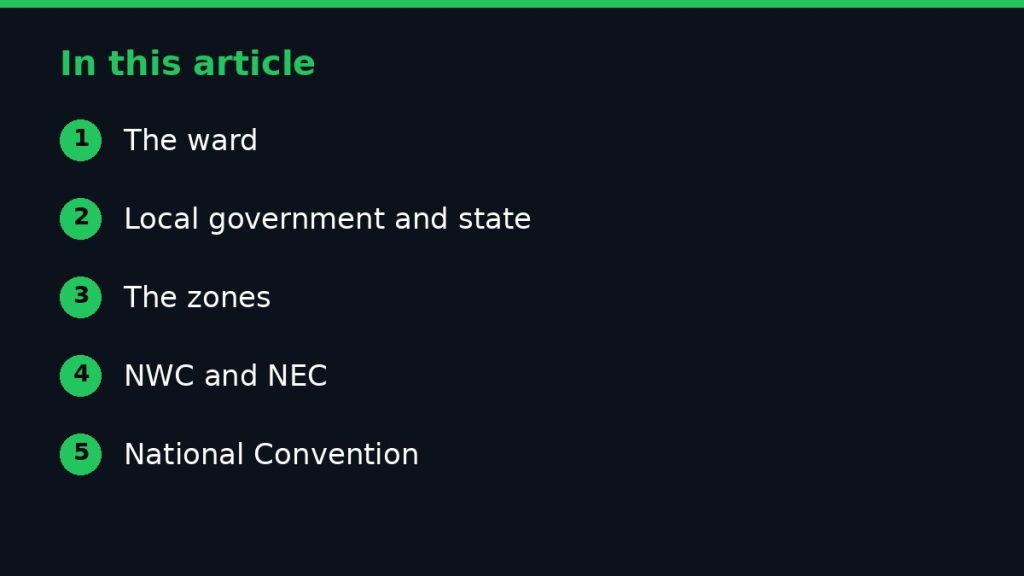
The levels at a glance
- Ward. The base unit, governed by a Ward Executive Committee.
- Local Government Area or Area Council. Governed by an LGA Executive Committee.
- Senatorial district. The constitution refers to a Senatorial District Executive Committee.
- State. Led by a State Executive Committee and a State Working Committee.
- Zone. A Zonal Executive Committee for each of the six geopolitical zones, whose chairman is a national vice chairman.
- National. The National Working Committee (NWC), the National Executive Committee (NEC) and the National Convention.
The ward: where it starts
Ward congresses elect the Ward Executive Committee and choose delegates to the local government and state congresses. According to the constitution text, ward delegates go on to the LGA and state level. Candidates for local government council chairman are selected through the ward congresses. Because the ward is the first place where membership is counted and delegates are named, disputes over the membership register often begin here, and the party carried out a clean-up of its register before the 2026 cycle.
Local government and state
The LGA congress elects the LGA Executive Committee and local government delegates to the state congress and the national convention. The state congress elects the State Executive Committee. The constitution lets the state, LGA and ward executives set up standing and ad-hoc committees, and it provides for appeals from ward to LGA to state level. State chairmen are important beyond their states, since they sit on the NEC.
The zones
The party groups its states into the six geopolitical zones: North-Central, North-East, North-West, South-East, South-South and South-West. Each has a zonal executive, and the zonal chairman doubles as a national vice chairman. In 2026 the convention also elected national ex-officio members by zone, such as Adamu Jallah for the North-East.
The National Working Committee
The NWC is the day-to-day management team. After the March 2026 convention it included the national chairman (Nentawe Yilwatda), deputy chairmen for the North (Ali Bukar Dalori) and South (Benjamin Obi Nwoye), the national secretary (Surajudeen Ajibola Basiru), a deputy secretary, a legal adviser, a treasurer, a financial secretary, organising and welfare secretaries, the publicity secretary (Felix Morka), an auditor, a women leader and a youth leader (Dayo Israel), along with deputies for several offices. The previous convention, in 2022, elected 77 national officials in total from a consensus list.
The National Executive Committee
According to Daily Trust, the NEC is the second highest decision-making organ and includes the president, vice president, governors who are party members, NWC members and state chairmen, among others. Article 13.3 of the constitution gives it powers to discharge the functions of the national convention between conventions. The NEC used that power to appoint Ganduje in 2023 and to ratify Yilwatda in July 2025. The NEC also met at the Presidential Villa in December 2025 to discuss preparations for congresses and campaigns.
The National Convention
The convention is the highest organ. The 8th National Convention was held at Eagle Square in Abuja on 27 and 28 March 2026, with more than 8,400 delegates, according to Channels Television. It re-elected Yilwatda and the NWC by consensus and voice vote, and officers serve four years. Delegates come from the state and LGA congresses, together with statutory delegates such as elected officials and party officers.
Why the structure matters
- Control of delegates. Whoever controls ward and local government structures influences primaries and conventions.
- Litigation. In 2022, Bayelsa delegates were excluded from voting at the national convention because of court cases over the ward, local and state congresses.
- Consensus. Most national officers in 2022 and 2026 emerged by consensus, which supporters say avoids damaging contests and critics say limits real competition.
- Caretaker committees. When the NEC dissolved the NWC in 2020, it set up a caretaker committee, showing how the NEC can reset leadership.
How to learn more
The party’s constitution is published, and the 2022 amended version was ratified at that year’s convention. Readers who want exact provisions on membership, discipline, zoning and the powers of each organ should read the current text and notices from the national secretariat.
What we could not confirm
- Whether later amendments changed the 2022 text.
- The current number of delegates entitled to vote at each level.
- Details of the Board of Trustees and other bodies not covered in the sources I reviewed.
Frequently asked questions
What is the highest organ of the APC? The National Convention.
What does the NEC do? It acts between conventions and can appoint or ratify officers.
How long do national officers serve? Four years, according to reports of the 2026 convention.
Key takeaways
The APC runs from ward to national level through executive committees, congresses and a national convention, with the NWC managing daily affairs and the NEC acting between conventions. Control of the lower levels shapes who becomes a delegate and therefore who leads.
Sources checked
- APC constitution (2022), as published by Premium Times
- Channels Television and Within Nigeria on the 2026 convention and officers
- BusinessDay and ThisDay on the 2022 convention
- Daily Trust via PressReader on the NEC and Article 13.3
- AllAfrica, “APC in 2025”
Educational content only — not financial advice. Income and savings results vary and are never guaranteed. How we write
Enjoyed this story?
Get the best stories delivered weekly.