APC and Election Campaign Strategies in Nigeria
Last checked: 14 October 2026. This article looks at APC and election campaign strategies in Nigeria using reported 2026 plans. It is civic education, not an endorsement of any party, and strategies reported here are the parties’ own claims.
APC and election campaign strategies in Nigeria combine party structure, messaging, alliances and travel. Winning a presidential election requires more than popularity: it needs organisation in every state. This guide looks at what the APC has said and done for 2027, with notes on how the opposition is approaching the same contest.
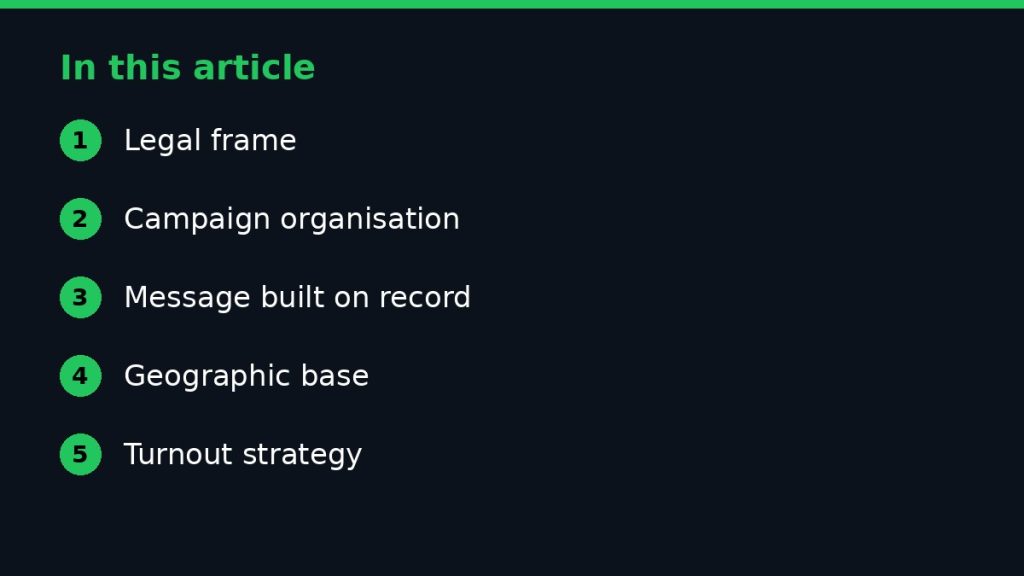
The legal frame for campaigns
Campaigns can only run within dates set by INEC. For the 2027 elections, presidential and National Assembly campaigns began on 19 August 2026, and governorship and state assembly campaigns began on 9 September 2026. All campaigns must end 24 hours before election day. The presidential and National Assembly vote is set for 16 January 2027, with governorship and state assembly elections on 6 February 2027.
A campaign organisation
The APC has named Senator Abdulaziz Yari, a former Zamfara governor, as director-general of its presidential campaign. The campaign council’s inaugural meeting was scheduled for 14 October at the State House in Abuja. A formal flag-off is planned for Kaduna on 24 October, followed by visits to Rivers State and Maiduguri and other parts of the country, according to ThisDay.
A message built on record
The campaign says it will present the administration’s record and seek a second term for Tinubu. Yari quoted Tinubu’s line, “We are not promising. We are doing it, and we are going to continue”, and said the message is about delivery instead of promises. Opposition parties argue that the record is mixed and that voters want change. Each side’s claims are best judged against independent data on prices, security and services.
A broad geographic base
The constitution requires a presidential winner to have the most votes and at least 25% in a wide spread of states. As described in the sources we reviewed, that means at least 24 of the 36 states and the FCT, although the Supreme Court held in 2023 that a candidate does not need 25% in the FCT. For the APC, this makes regional balance important. Yari claimed the president controls more than ten states in each of the North and South, which is a party claim we could not independently verify.
Related link: Read more here
Governors and state machinery
BusinessDay reported on 9 March 2026 that the APC had 31 of 36 governors after the Zamfara governor defected from the PDP. Governors command state party structures, local campaign funds and relationships with local government leaders. That gives the APC a ground network in most states. Opposition parties note that defections do not always translate into votes, and the 2023 result showed that popular local candidates from other parties can still win.
Alliances and defections
Parties build coalitions. The APC itself began as an alliance in 2013, and the opposition has regrouped too: Atiku Abubakar is running on the ADC, Peter Obi on the NDC and Oluseyi Makinde on the APM, according to INEC’s final list. Many voters are following how these candidates divide or combine the non-APC vote.
Grassroots mobilisation
Campaigns use rallies, door-to-door visits, women and youth groups, traditional and religious leaders, and market and transport unions. Atiku’s ADC council was told to reach markets, motor parks, farms, campuses and communities, which shows that both sides see grassroots contact as central. The APC’s advantage lies in the reach of its state structures, while challengers rely on enthusiasm and local networks.
Media and digital outreach
Parties use radio, television, newspapers and social media to push messages and respond to rivals. Digital tools make it quick and cheap to reach young voters, but they also spread misinformation. Voters should check claims against official sources before sharing them.
Turnout strategy
Turnout fell from 43.65% in 2015 to 34.75% in 2019 and 26.71% in 2023. For any party, getting its own supporters to collect their Permanent Voter Cards and vote is a core task. INEC’s guide says voters must vote in person with a valid card at their assigned polling unit, so parties try to help supporters meet that requirement.
Polling-day protection
Parties deploy agents to polling units and collation centres to witness counting and record results on Form EC8A. Under the 2026 Act, results are to be transmitted electronically to IReV, with a manual fallback. Trained agents and lawyers help parties document problems and, if necessary, prepare petitions.
Spending rules
Electoral law limits campaign spending. The 2022 Act capped presidential campaign spending at ₦5 billion, but we did not confirm whether the 2026 Act changed it. Transparency about funds is a recurring demand from observers.
What we could not confirm
- The APC’s detailed budget, manifesto or state-by-state strategy.
- Whether the 2026 Act changed spending limits.
- The truth of each party’s claims about state control or support.
Frequently asked questions
When did campaigns start? 19 August 2026 for presidential and National Assembly races.
Who directs the APC presidential campaign? Senator Abdulaziz Yari.
When do campaigns end? 24 hours before polling day.
Key takeaways
The APC’s reported strategy rests on its record, its network of governors, a wide geographic spread and organised mobilisation. Opposition parties emphasise change and local contact. Voters can compare claims with independent facts.
Sources checked
- ThisDay, Tinubu to kick off campaign in Kaduna on 24 October, 10 October 2026
- AllAfrica, INEC reschedules 2027 elections, 27 February 2026
- BusinessDay, APC governors rise to 31, 9 March 2026
- Nairametrics, INEC final list of 18 presidential candidates, 12 September 2026
- Wikipedia, 2023 Nigerian general election, for turnout figures
Educational content only — not financial advice. Income and savings results vary and are never guaranteed. How we write
Enjoyed this story?
Get the best stories delivered weekly.