How to Budget When Your Income Is Irregular
Standard budgeting advice assumes you receive the same amount on the same date every month. If you are a freelancer, trader, driver, seller or anyone paid in uneven amounts, that advice falls apart. One month you have more than enough, the next barely covers rent. This guide explains a practical way to budget when your income moves up and down, so you can pay bills on time and stop living in a constant state of worry.
Start by understanding your real numbers
Gather the last six to twelve months of income if you can. Write down what came in each month, then find the lowest month and the average month. These two figures are the foundation of your plan. Your lowest month shows what you can rely on in a bad period; your average shows what you earn over time.
List your essential expenses
Next, write every cost you cannot skip: housing, food, transport, utilities, school fees, minimum debt payments and basic phone or data. Add them up. This is your survival number. Everything above it is flexible. Knowing this number takes away much of the fear, because you can see exactly how much you must earn to stay safe.
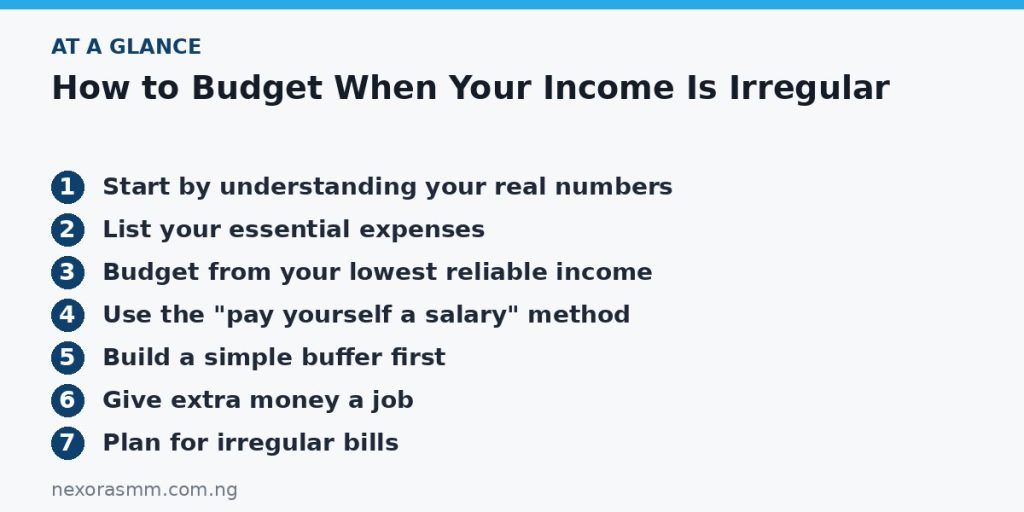
Budget from your lowest reliable income
Plan your regular spending as though you will earn your lowest typical amount. When a month turns out better, the extra money goes to a prearranged plan instead of disappearing. This approach feels strict at first but is the secret to stability.
Use the “pay yourself a salary” method
Instead of spending money the moment it arrives, open a separate account or wallet where all income lands. Each month, transfer a fixed “salary” to your spending account, based on your average income and survival number. In good months, the buffer grows. In poor months, the buffer pays your salary. This turns irregular income into a steady stream you can plan around.
Build a simple buffer first
Aim to hold at least one month of essential expenses in the income account. Once you reach that, build towards three months. If that sounds impossible, begin with a small weekly amount. Even a modest buffer stops a slow month from becoming a crisis.
Give extra money a job
When you earn more than your salary target, divide the surplus using a simple split such as:
- Buffer: until you reach your target
- Debts: extra payments on the most expensive debt
- Irregular bills: set aside for annual costs such as taxes, insurance and school fees
- Small reward: a modest amount for enjoyment so the plan stays sustainable
Plan for irregular bills
Annual or quarterly expenses surprise people. List them, divide each by the number of months until it is due and save that amount monthly in a separate pot. When the bill arrives, the money is waiting.
Set aside money for tax if it applies
Self-employed people often forget that income may be taxable. Learn the rules where you live and put aside a percentage of each payment in a separate account so a bill does not catch you off guard. If you are unsure, ask a qualified tax adviser.
Smooth your cash flow
- Invoice promptly and state clear payment dates.
- Ask for deposits on larger projects.
- Diversify clients so one late payment does not stop everything.
- Keep a short list of non-essential costs you can pause quickly.
Track in the simplest way possible
Use a notebook, a spreadsheet or a basic budgeting app. Each week, spend ten minutes recording what came in, what went out and how the buffer looks. The habit matters more than the tool. Review monthly and adjust your salary figure up or down.
A worked example
Imagine your income over six months was 90,000, 150,000, 60,000, 120,000, 100,000 and 80,000. Your average is about 100,000 and your lowest month is 60,000. Your essential expenses total 70,000. You set your personal “salary” at 75,000, a little above your survival number and below your average. In the 150,000 month, you pay yourself 75,000 and leave the rest in the buffer. In the 60,000 month, you still pay yourself 75,000 by drawing 15,000 from the buffer. Over time the buffer smooths the ups and downs, and you know exactly how much you can spend each month.
Review every quarter
Every three months, recalculate your average and lowest income. If your earnings have grown, raise your salary slightly and increase your savings. If they have fallen, trim non-essential costs early rather than waiting until the buffer runs out.
Frequently asked questions
What if my lowest month does not cover essentials? Look for ways to reduce your survival number, add a second source of income or negotiate payment terms. You may also need to speak with creditors early rather than waiting until you miss payments.
Should I pay debt or build a buffer first? Start with a small buffer so an emergency does not push you into more debt, then increase debt payments.
How long before this feels normal? Many people notice a calmer feeling after two or three months of following the method.
Is a spreadsheet necessary? No. A notebook works if you use it consistently.
Key takeaways
Know your lowest and average income, calculate your survival number, pay yourself a steady salary from a buffer account and give extra money a clear job. Irregular income is harder to manage, but a simple system brings back control.
Educational content only — not financial advice. Income and savings results vary and are never guaranteed. How we write
Enjoyed this story?
Get the best stories delivered weekly.