How to Represent African Stories Authentically With AI

AI image and video tools produce a lot of images that look vaguely African and are specific to nowhere. After reading this, you will be able to recognise the most common failures, write prompts anchored in a real place and community, and run a simple review process before you publish anything.
Why generic “Africa” imagery is a craft problem, not only an ethical one
Africa is a continent of 54 countries, with thousands of languages and cultures that differ as much as Norway and Portugal do. Image models learn from whatever material they were trained on, and that material often flattens the continent into a handful of repeated visuals: red dust roads, a lone baobab, beads, and a sunset behind a silhouette. If your prompt says only “an African village”, you are asking the model to guess, and the guess is usually an average of clichés.
This matters for storytelling as much as for respect. A film that could be set anywhere has no texture, and audiences from the place you are depicting notice the wrong details immediately. Specificity is what makes a scene feel lived in, and it is also what protects you from misrepresenting people.
The failure modes to watch for in your outputs
Learn to recognise these patterns, because they appear even in polished-looking frames.
- The blended culture: clothing, architecture and props from different regions combined in one frame, such as a Yoruba-style head wrap beside a Maasai-style shawl in a Lagos setting.
- The poverty default: when you leave the setting open, models may lean toward hardship imagery. Modern Nairobi offices, Accra cafes and Ibadan university lecture halls rarely appear unless you ask for them.
- Costume as everyday wear: ceremonial attire shown on someone buying vegetables, or “traditional” dress used where a character would plainly wear jeans or a school uniform.
- Wrong or invented writing: signs, banners and fabric text that look like lettering but say nothing, or scripts that belong to another language.
- Monolithic landscapes: savanna used for countries and regions that are mostly forest, coast, highland or desert.
- Flattened faces and bodies: repeated features, skin tones rendered unevenly, or hair textures and styles that look wrong for the era or setting.
Keep this list beside your monitor while you review frames. Naming the problem makes it far easier to fix in the next prompt.
Start with a precise region, community and moment
Before you write any prompt, answer four questions in a notebook: which country, which city or region, which community or language group, and which decade. A story set in a Hausa household in Kano during the dry season looks different from one set in an Igbo family compound in Enugu at Christmas, and both differ from a Gĩkũyũ family in Nyeri.
Then translate those answers into visible, concrete details: building materials, street layout, vehicles, signage languages, food, school or work clothing, and weather. Use names that fit the community, and put them in your script and prompts so characters feel like individuals rather than types.
Example prompt: Late afternoon in a Kano neighbourhood during the dry season, a teenage girl in a school hijab and plain uniform walks home along a sandy lane lined with cream-coloured walls, a boy on a motorcycle passes in the background, harmattan haze softens the light, medium tracking shot, natural documentary style, no text on signs.
Example prompt: Interior of a modern Accra co-working space at midday, a young woman in a smart casual shirt types at a laptop while a colleague pours water at a counter, warm window light, shallow depth of field, calm and ambitious mood, contemporary everyday setting.
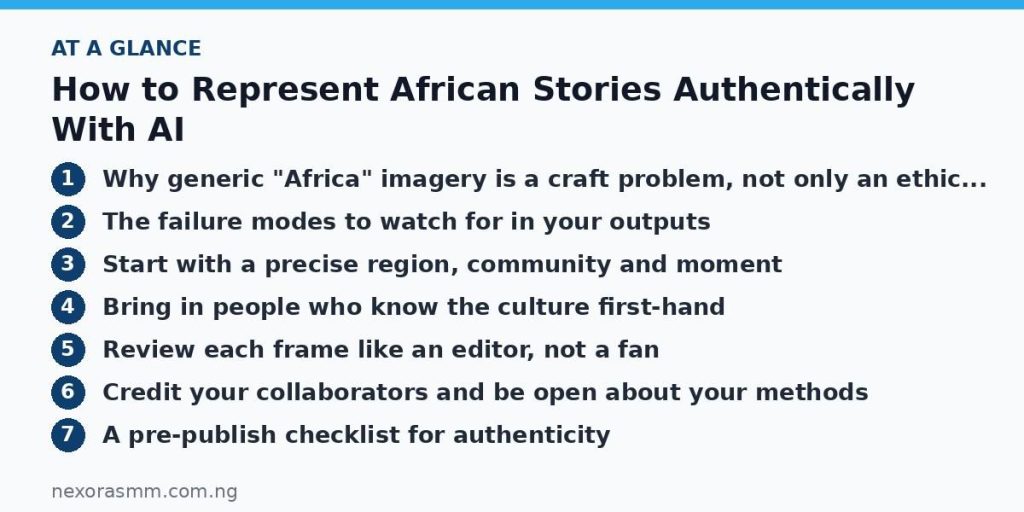
Bring in people who know the culture first-hand
No prompt can replace someone who has lived the details. If your story is not from your own community, find cultural consultants early: a relative, a friend, a local historian, a language teacher, or a community organisation. Ask them to read your script and look at your reference board before you generate anything, rather than after you have fallen in love with the frames.
Ask open, practical questions. What would this family really eat at this time of day? How do people greet an elder here? What would be inappropriate to show? What is missing from this room? Compensate people fairly for their time wherever you can, and be ready to change your plan when they tell you something is wrong.
Your own community deserves the same scrutiny. Showing your frames to older relatives or to friends from other generations often reveals details you have stopped noticing. If you are building period scenes, the research steps in our guide to historical African films apply here as well.
Review each frame like an editor, not a fan
Generating several variations is normal, and results vary between tools, so do not accept the first pleasing frame. Check each one against a fixed set of questions: Is the clothing right for this person, place and occasion? Do the buildings match the region? Is any text readable, and is it in the correct language? Are the faces varied across characters? Does the frame show dignity, or does it use hardship as decoration?
When something is wrong, fix it in the prompt by being more specific rather than adding more adjectives. Replace “traditional African outfit” with a plain description of the actual garment and fabric your consultant confirmed. If the tool keeps failing at a detail, cut around it, crop it, or avoid showing it. A wrong detail removed is better than a wrong detail published.
Characters also need to stay recognisable between shots, which helps you avoid slipping into stereotyped faces; our article on consistent movie characters explains how to lock down a character description.
Credit your collaborators and be open about your methods
Name the consultants, translators, musicians and actors who shaped the work, with their permission. If voices, music or writing came from real people, say so in the credits. Be honest with audiences that AI tools were part of your process, since that openness builds trust and gives viewers context for what they are watching.
Treat AI frames as a visual interpretation, not a record. If you are depicting a real community, offer to share the finished film with them, and listen to any objections. Respectful filmmaking is a relationship that continues after you export.
A pre-publish checklist for authenticity
- Have I named the exact country, region, community and time period in my notes?
- Did someone from or very familiar with this culture review the script and frames?
- Are clothing, architecture, food and props consistent with one place and era?
- Is all visible text correct, or has it been removed?
- Do the characters have individual names, motives and faces, not just roles?
- Does the film show the people in it as full human beings with ordinary and extraordinary moments?
- Have I credited collaborators and stated how AI was used?
- Am I prepared to correct or remove anything if the community points out a problem?
Key takeaways
- Generic prompts produce generic or mixed-up imagery, so specify country, region, community and era every time.
- Watch for blended cultures, poverty defaults, costume misuse and gibberish text in every frame.
- Consult people who know the culture before you generate, and pay them fairly where possible.
- Review outputs critically, fix details with precise wording, and cut around what the tool cannot get right.
- Credit collaborators and be open about your use of AI.
Educational content only — not financial advice. Income and savings results vary and are never guaranteed. How we write
Enjoyed this story?
Get the best stories delivered weekly.