How to Save Money on a Low Income: Practical Steps That Work
Saving money feels almost insulting when every naira, dollar or pound is already spoken for. Yet small, consistent savings are what protect a low-income household from emergencies and debt. This guide offers practical ways to find extra money in your budget, reduce common costs and build savings step by step, without pretending that it is easy.
Start by seeing where the money goes
For one month, write down everything you spend, even small amounts. Group it into categories: housing, food, transport, data and phone, utilities, school costs, health, debt payments and everything else. Many people discover that small, frequent purchases add up to a surprising total. You cannot change what you cannot see.
Separate needs from wants
Needs are essential costs: rent, basic food, transport to work, utilities and necessary health costs. Wants are things you enjoy but could reduce. You do not have to give up everything you enjoy. Instead, choose a small number of things that give you the most pleasure and cut back on the rest.
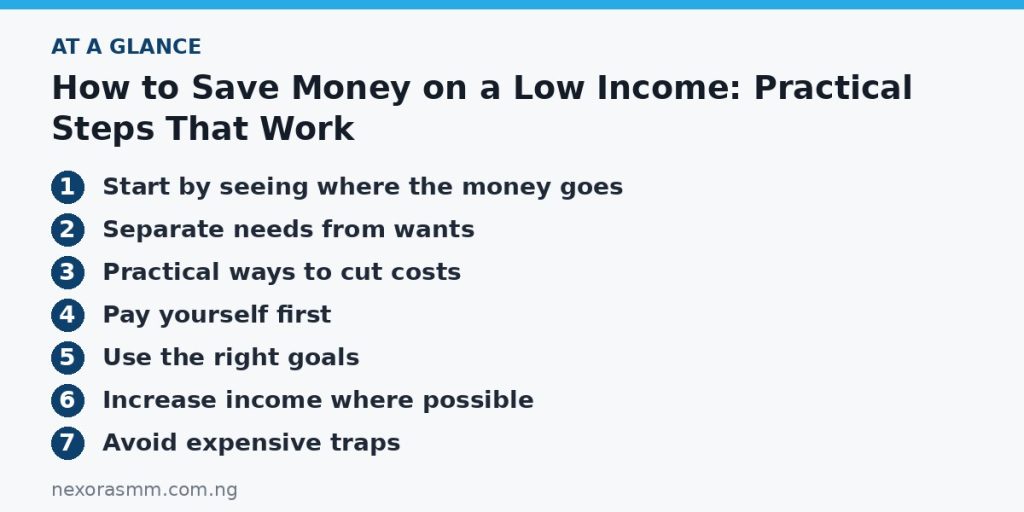
Practical ways to cut costs
Food
- Plan meals for the week and shop with a list.
- Buy staples in larger packs when you can afford it and store them safely.
- Cook larger portions and use leftovers.
- Buy seasonal produce, which is often cheaper.
Transport
- Combine errands into fewer trips.
- Walk or share rides when practical.
- Maintain vehicles regularly to avoid expensive breakdowns.
Phone and data
- Compare bundles and choose the one that matches how you actually use data.
- Use free Wi-Fi safely when available.
- Cancel subscriptions you rarely use.
Electricity and utilities
- Switch off devices that are not in use and use efficient bulbs.
- Do not leave chargers plugged in unnecessarily.
- Check bills for errors and ask about any charges you do not understand.
Pay yourself first
Do not wait to see what is left at the end of the month. Decide on a small saving amount, even one that feels too small, and move it as soon as you receive income. Put it somewhere separate and safe. A habit of saving a little often is more important than the amount at the beginning.
Use the right goals
Save in this order: first a small starter emergency fund, then clear expensive debt, then build a larger safety net, and only then think about other goals. Write the goal down and track progress, because seeing the number grow keeps you motivated.
Increase income where possible
Cutting costs has a limit, while earnings can grow. Look for realistic ways to increase income: extra hours, selling a skill, a small side business or seasonal work. Decide in advance that a fixed portion of any extra income goes into savings.
Avoid expensive traps
- High-interest loans and “buy now, pay later” offers that you cannot afford to repay.
- Sales that make you buy things you did not plan to buy.
- Investment promises that guarantee fast profit.
- Paying fees for services that were meant to be free, such as basic bank services you never use.
A sample plan for one month
Week one, record every expense and note three that surprised you. Week two, make a weekly meal plan and shop with a list, then compare the total with the previous week. Week three, review your phone, data and subscription costs and cancel or reduce anything you barely use. Week four, set up a small automatic transfer to a separate savings pot on payday and write down your first goal, such as a starter emergency fund. After a single month of this, most households find at least a little money they did not know they had, and they have a system for keeping it.
Do not carry guilt
If a month goes badly because of an emergency, that is exactly what savings are for. Use the money if you need it, then restart the habit. Saving on a low income is not about perfection; it is about slowly building a cushion so that the next problem is smaller.
Frequently asked questions
How much should I save? Start with whatever you can, even a small fixed amount. Increase it slowly as your situation improves.
Is it better to save or pay debt? Build a small emergency buffer first, then pay down expensive debt faster.
What if I have nothing left at the end of the month? Re-check your spending record for small cuts, and look for ways to add income. Even saving a very small amount builds the habit.
Where should I keep my savings? Use a safe, regulated account or wallet that you can access in emergencies, not a place that locks the money or carries high risk.
Key takeaways
Track your spending, separate needs from wants, trim the biggest costs, save a small amount as soon as you are paid and look for ways to earn more. Progress will be slow, but steady habits create security over time.
Educational content only — not financial advice. Income and savings results vary and are never guaranteed. How we write
Enjoyed this story?
Get the best stories delivered weekly.