Nigerian Loan Apps in 2026: How to Check a Lender Is Registered Before You Borrow
Last checked: 10 October 2026. Figures come from published news reports on the regulator’s updates; they change often, so confirm on the official register before you borrow.
Digital loan apps are popular in Nigeria because they are fast. They are also where many borrowers meet hidden fees, threatening messages and apps that read the contacts on a phone. The rules for this market changed recently, and the changes give you a practical way to protect yourself: checking whether a lender is registered before you borrow. This guide explains the new regulations, what the regulator has reported so far and how to run a five-minute check on any app.
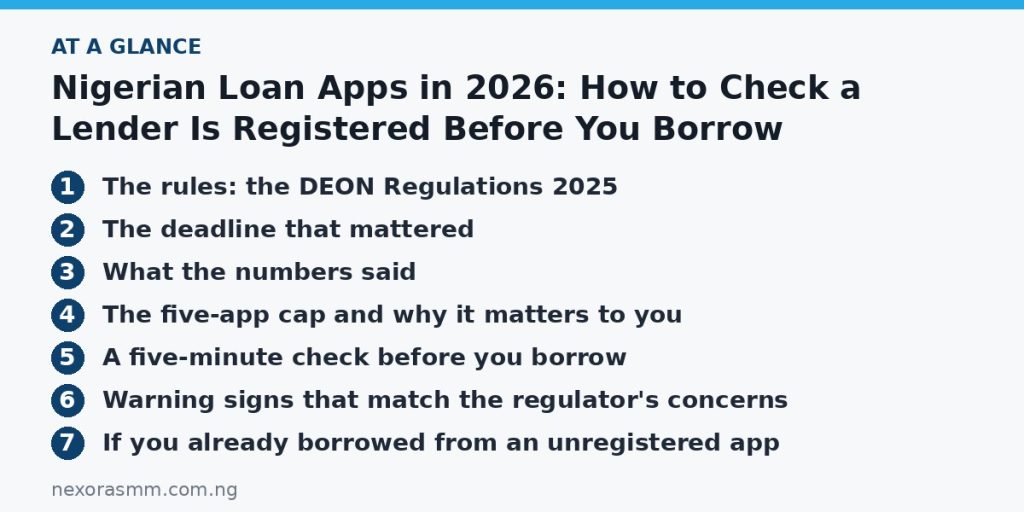
The rules: the DEON Regulations 2025
Nigeria’s Federal Competition and Consumer Protection Commission, known as the FCCPC, issued the Digital, Electronic, Online and Non-Traditional Consumer Lending Regulations, 2025, usually shortened to the DEON Regulations. According to reports, they apply to unsecured consumer lending delivered through electronic, online, mobile or other non-traditional means. The rules cover registration, transparency, data privacy, ethical debt recovery, fair interest and responsible lending. They build on a 2022 framework that had already made registration compulsory for digital money lenders. A notable change is that the rules reach lenders that do not use an app at all.
The deadline that mattered
Lenders were first told to register by 31 October 2025, and the deadline was later extended to 5 January 2026. After that date passed, the FCCPC announced phased enforcement against lenders that had not regularised. Reported penalties include removal of apps from digital stores, fines of up to ₦100 million or one percent of annual turnover, suspension of operations and disqualification of directors. Lenders given provisional status were reportedly given until April 2026 to complete their registration.
What the numbers said
In early January 2026, press reports counted 521 digital lenders under FCCPC oversight, 457 of them with full approval and the rest conditional, with more than 100 unregistered apps on a watchlist. A later report said the number of fully approved lenders had risen to 505, that another 32 lenders were exempt from registering because the Central Bank of Nigeria already licenses them, and that more than 1,000 apps were under the Commission’s oversight. That report also said 112 apps remained on the watchlist and 54 had been removed from the Google Play Store for breaching the rules. These are reported figures, not official statistics I could verify, so use them to understand the scale rather than to quote exact numbers.
The five-app cap and why it matters to you
The FCCPC has also moved to limit each lender to a maximum of five lending apps, and approved lenders must disclose every app they use. Industry voices quoted in the reporting say some firms run many apps under different names, which makes it hard to know who you are dealing with. The practical lesson: a pleasant app name tells you nothing. Find the company behind it.
A five-minute check before you borrow
- Find the company name. Look in the app’s description, privacy policy and loan agreement for the legal name of the lender, not just the brand.
- Check the official register. The FCCPC publishes a register of approved digital lenders. Search for the company name and confirm that the app you are using is listed against it. Use the Commission’s own website or verified social accounts, not a link sent in a message.
- Check for a CBN licence. Some lenders are exempt from FCCPC registration because the Central Bank of Nigeria licenses them. Confirm this on the lender’s official channels and the regulator’s lists.
- Read the permissions. An app asking for your contacts, photos or messages when it only needs your bank details deserves caution.
- Calculate the total repayment. Ask for the full amount you will repay and the dates. Compare it with the amount you will receive.
- Save evidence. Keep screenshots of the offer, the terms and every payment.
Warning signs that match the regulator’s concerns
- The lender asks you to pay a fee before releasing the loan.
- The app is not on the register, or the registered name does not match.
- Collectors message your contacts or threaten to shame you.
- The terms on screen differ from the agreement you were sent.
- The repayment period is extremely short with high charges.
If you already borrowed from an unregistered app
Do not panic and do not take a new loan to repay the old one. Keep records of every message and payment. Report harassment or illegal data use to the FCCPC through its official channels and tell your bank if the app has your card details. If you feel threatened, report to the police. Pay what you legally owe through traceable methods and ask for a written statement of the balance.
What we could not confirm
- The exact current number of approved and watchlisted apps, which changes as the regulator updates its register.
- Whether a specific app you are considering has changed its registration status since the reports above.
Frequently asked questions
Is every registered lender safe? No. Registration is a minimum check, not a guarantee. Still read the terms and compare costs.
Can I borrow from a lender that is not on the register? It is risky, because the regulator says such lenders face enforcement and may disappear or be removed from app stores.
What if the app was removed from the store? Keep your records, check how to repay safely and report problems to the regulator.
Key takeaways
Registration became compulsory under the DEON Regulations, enforcement started after 5 January 2026 and the regulator publishes a register you can check. Identify the company, confirm registration, read permissions and calculate the full cost before you accept any loan.
Sources checked
- Nairametrics, “Loan apps: 521 companies now on FCCPC’s radar as January deadline lapses” (January 2026)
- The Guardian Nigeria, “FCCPC moves against unregistered loan apps, revokes conditional approvals”
- BusinessDay, report on the FCCPC crackdown on digital lenders
- MSME Africa, “FCCPC Grants Full Approval to 505 Digital Lenders”
- MSME Africa, “FCCPC Caps Digital Lending Apps at Five”
Educational content only — not financial advice. Income and savings results vary and are never guaranteed. How we write
Enjoyed this story?
Get the best stories delivered weekly.