AdSense ‘Low Value Content’: What Google’s Guide Says and a 12-Question Self-Audit
Last checked: 10 October 2026. This article draws on Google’s AdSense Community guide on “low value content” and on 2026 approval guides from other publishers. Google does not publish a numbered approval checklist, so treat third-party advice as informed opinion, not rules.
“Low value content” is the most common AdSense rejection reason, and it is also the least helpful message you can receive, because it does not tell you which page is the problem. Google’s own community guide on the subject gives a few important clues. This article explains what that guide says in plain terms, separates the official requirements from popular myths and turns the advice into a twelve-question audit you can run on any website, including your own.
What Google’s guide says
Google’s AdSense community guide says content value is judged through the lens of experience, expertise, authoritativeness and trustworthiness, often shortened to E-E-A-T. It warns that putting together a collection of pages simply to qualify for AdSense may not work, and that sites that slip through with weak content can face severe ad limits later, which effectively means little or no earning. It also says the site should be text-based and about policy-compliant topics, and that original, valuable and substantial content is the target. It recommends having a privacy policy and terms of service.
The key idea is a shift in question. Do not ask “how many posts do I need?” Ask “why would a real person choose this site over the many others that cover the same topic?”
What the official eligibility requirements actually include
Guides that summarise Google’s eligibility page describe four basics: you own the site and its content, the content follows AdSense policies, you meet the minimum age, which is 18, and you have a privacy policy that explains cookies and advertising. One 2026 guide points out that traffic volume is not on the eligibility page, which is why people who insist you need a certain number of daily visitors are repeating a myth. Another source lists a typical review time of one to fourteen days, but that is a general estimate, not a promise.
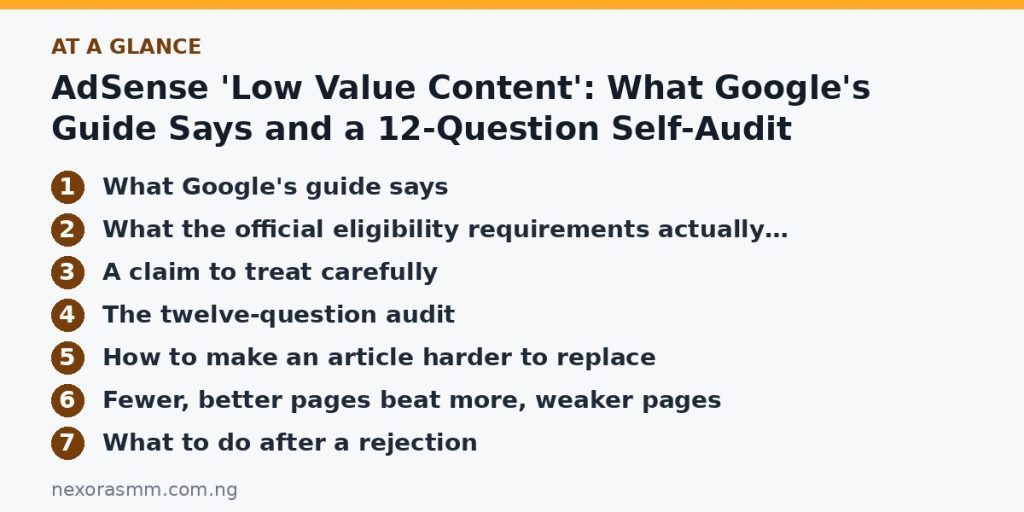
A claim to treat carefully
Some 2026 blog posts say AdSense has become stricter about AI-generated content. I could not confirm that from an official Google source. What is safe to say is that Google’s guidance rewards experience and expertise, and text that adds nothing beyond what a tool can produce in seconds is exactly the kind of content that struggles to show either one.
The twelve-question audit
- Could any other site publish this article word for word? If yes, it is replaceable. Add something only you have.
- Does each article contain at least one original element? Examples include a screenshot of a process you actually followed, a calculation you did, a local price you checked or an interview.
- Are claims dated and sourced? Rules, fees and thresholds change. Say when you checked and where.
- Are the articles about one clear subject? A site that mixes unrelated topics looks assembled for traffic.
- Is there a real author? Use a real name, a short bio that describes relevant experience and a way to contact you.
- Do About and Contact pages say who runs the site? Vague pages weaken trust.
- Does the Privacy Policy mention advertising, cookies and third-party vendors such as Google?
- Are there empty categories, placeholder posts or “coming soon” pages? Remove them.
- Do articles repeat each other? Merge near-duplicates into one stronger page.
- Does the page answer the question quickly? Long introductions that say nothing are padding.
- Is the layout usable on a phone? Check text size, menus and loading speed.
- Is the site indexed? Search for site:yourdomain.com and use Search Console to see which pages Google knows about.
How to make an article harder to replace
- Use first-hand evidence. If you explain how to register a business, include what the official portal actually showed you, with your own screenshots, and say what confused you.
- Use local detail. A page about borrowing money in Nigeria should mention the Nigerian regulator and the rules in force, not generic advice that could apply anywhere.
- Add a decision tool. A calculator, a checklist or a comparison table gives readers something to use, not just read.
- Update visibly. Add a “last checked” date and revise the article when facts change.
- Cite sources by name. Readers and reviewers can see that you did the checking.
Fewer, better pages beat more, weaker pages
If your site has dozens of short articles that cover similar ground, consider combining them. Ten pages that each contain something no one else offers are a stronger application than forty that read like each other. Remove or rewrite pages that you would be embarrassed to show a stranger.
What to do after a rejection
Read the reason in your AdSense account, fix the underlying problem rather than making small cosmetic edits and give the changes time to be crawled before you reapply. Reapplying immediately with the same content rarely changes the result.
What we could not confirm
- How many articles are enough. Google does not publish a number.
- Any special rule for AI-assisted writing beyond the general quality standards.
- Exact review times, which vary by account.
Frequently asked questions
Do I need traffic before applying? Guides summarising Google’s eligibility page say traffic is not an official requirement, but real readers are a good sign of value.
Can I use AI to draft articles? You can use it as a tool, but you must add genuine experience, check facts and write in a way that is useful to people, not just to search engines.
Does a rejected site stay rejected? No. Many publishers are approved after improving their content and policies.
Key takeaways
Low value content means pages that offer nothing distinctive. Show who you are, add original evidence, keep the site focused, date your facts and remove filler. Run the twelve-question audit and fix what fails before you reapply.
Sources checked
- Google AdSense Community, “How can you solve the ‘low value content’ AdSense disapproval challenge?”
- TheGuideX, “Google AdSense Approval in 2026: The Real Eligibility Requirements”
- EastonDev, “Google AdSense Application and Review: A Complete Checklist (2026)”
- AdPushup, “Google AdSense approval” guide
Educational content only — not financial advice. Income and savings results vary and are never guaranteed. How we write
Enjoyed this story?
Get the best stories delivered weekly.