How to Calculate Dividend Income From Shares
Last checked: 13 October 2026. The calculations below are simple arithmetic using real 2026 dividend amounts as examples. This is general education, not financial advice, and future dividends are never guaranteed.
You do not need a spreadsheet to work out how much a dividend will pay you. You need three numbers: how many shares you own, how much the company pays per share, and the tax taken from the payment.
The basic formula
Gross dividend = number of shares × dividend per share.
If you own 2,000 shares and the company pays ₦1.50 per share, your gross dividend is 2,000 × ₦1.50 = ₦3,000.
Subtract withholding tax
Dividends from Nigerian companies are normally paid after 10% withholding tax. So net dividend = gross dividend × 0.90. On ₦3,000 gross, tax is ₦300 and you receive ₦2,700. Whether anything further is due depends on your own tax position, so ask a qualified tax adviser.
Example 1: A bank final dividend
Zenith Bank’s final dividend for 2025 was ₦8.75 per share, paid in May 2026. With 500 shares:
- Gross: 500 × ₦8.75 = ₦4,375
- Tax at 10%: ₦437.50
- Net: ₦3,937.50
Example 2: Two payments in a year
GTCO paid ₦1.00 around October 2025 and ₦11.76 in April 2026, according to StockAnalysis. Holding 1,000 shares across both payments:
- Gross: 1,000 × (₦1.00 + ₦11.76) = ₦12,760
- Net after 10% tax: ₦11,484
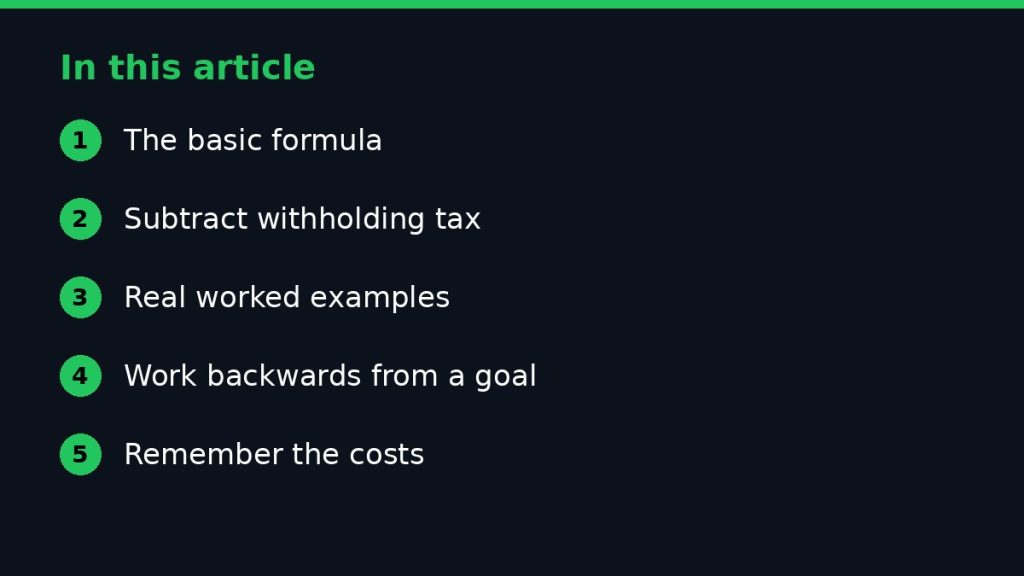
Example 3: A higher-priced share
Dangote Cement paid ₦45 per share for the prior year. If you own 100 shares, gross is ₦4,500 and net is ₦4,050. You need far fewer shares to earn a similar amount than with a low-priced share, but a higher share price also means a larger outlay.
Work backwards from a target
To see how many shares you would need to earn a certain net income, reverse the formula. Say you want ₦100,000 a year after tax from a stock paying ₦10 per share a year.
- Gross needed: ₦100,000 ÷ 0.90 ≈ ₦111,111
- Shares needed: ₦111,111 ÷ ₦10 ≈ 11,111 shares
At a ₦297 share price, which was BUA Cement’s approximate price at the end of September, that would cost about ₦3.3 million. This shows how large a portfolio income goals can require.
Remember the costs
Buying shares involves commission and fees. One guide estimates roughly 1.5% to 2.5% per transaction, depending on the broker. That reduces the money actually invested, and therefore the dividends you receive. Include it when you compare your income with what you spent.
Adjust for stock splits and bonus shares
If a company issues bonus shares, your number of shares rises while the dividend per share may be adjusted. Always use the current share count and the per-share amount from the latest notice.
Common calculation mistakes
- Using the gross figure and forgetting tax.
- Mixing up annual and half-year amounts.
- Counting a dividend you were not on the register to receive.
- Assuming last year’s dividend will repeat.
What we could not confirm
- Any future dividend per share.
- Whether special tax rules apply to you.
Frequently asked questions
Is the dividend per share the same for everyone? Yes, within the same class of shares.
Do I get a dividend for shares I just bought? Only if you are registered by the qualification date.
Is the amount in my bank account the gross figure? No, normally it is smaller after tax.
Key takeaways
How to Calculate Dividend Income After Tax
Understanding how to calculate dividend income is essential for investors who want to estimate the money they may receive from their stock investments. By calculating expected dividends and accounting for taxes, investors can make better financial plans and avoid unrealistic income expectations.
The first step is to determine your total dividend income before tax. Multiply the number of shares you own by the dividend declared per share.
For example, if you own 200 shares in a company that declares a dividend of ₦25 per share, your gross dividend income will be:
200 × ₦25 = ₦5,000.
If a 10% tax applies, the estimated tax would be ₦500, leaving you with ₦4,500 after tax. This calculation assumes the 10% rate applies to your dividend and excludes any additional charges.
Next, consider your actual investment cost. If you purchased the 200 shares at ₦150 each, your share purchase cost would be ₦30,000, excluding brokerage fees and other transaction charges. Comparing your after-tax dividend income with this cost helps you estimate your net dividend yield.
Using these figures, your after-tax dividend yield would be 15% for the relevant dividend period, assuming the entire dividend is received as calculated. Remember that this is not necessarily an annual return unless the dividend and investment period support that interpretation.
Most importantly, never build your income budget around a dividend that has not been officially declared. Companies can change dividend plans, and payments depend on factors such as financial performance and shareholder approval.
Smart investing involves checking official announcements, confirming applicable tax rules, and understanding the costs of buying shares. Careful calculations help you distinguish realistic dividend income from expectations that may never materialise.
The goal is simple: invest using confirmed information, calculate your net income carefully, and never spend money you have not actually received.
Sources checked
- StockAnalysis, GTCO and Zenith Bank dividend pages
- Mansa Markets, dividends declared in 2026 (Dangote Cement)
- NGN Market, on withholding tax on Nigerian dividends
- NairaCompare, beginner’s guide to buying shares on the NGX
Educational content only — not financial advice. Income and savings results vary and are never guaranteed. How we write
Enjoyed this story?
Get the best stories delivered weekly.