How to Set a Monthly Stock Investment Budget
Last checked: 13 October 2026. This is a budgeting framework with illustrative numbers, not financial advice. Adjust it to your own income, expenses and goals.
A monthly investing budget turns “I should invest” into a number you can actually follow. The goal is an amount you can keep paying in good months and bad ones.
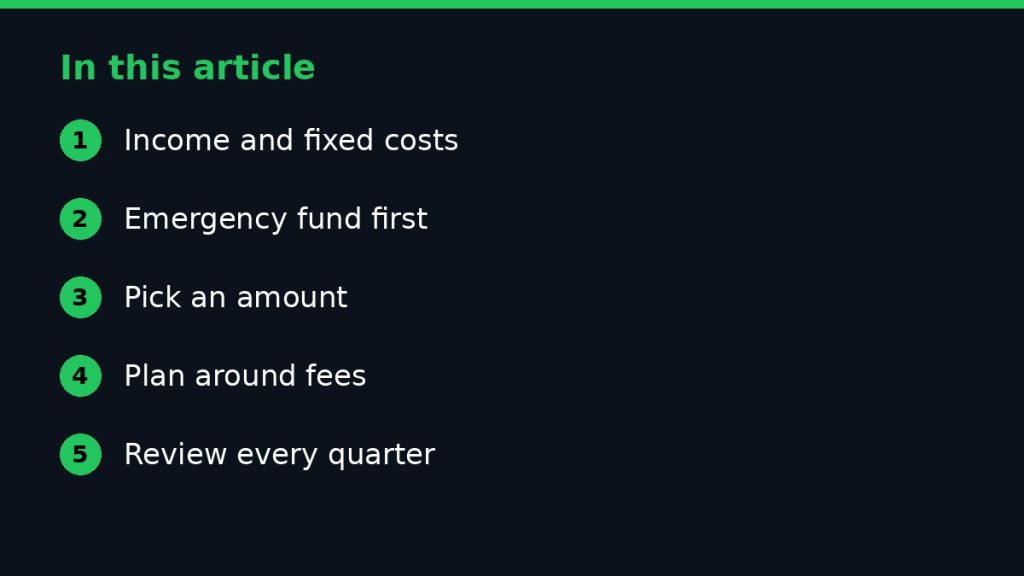
Step 1: List your income and fixed costs
Write down what you take home each month, then subtract rent, food, transport, bills and loan repayments. What remains is your starting point. Be honest, because an over-optimistic budget collapses by the second month.
Step 2: Protect an emergency fund
Before investing, aim to hold some savings for emergencies, commonly several months of essential spending, though even a smaller cushion helps. Shares can fall: the NGX All-Share Index dipped about 9% from its 13 May 2026 peak to 30 June. If you need cash at the wrong moment, an emergency fund stops you selling at a loss.
Step 3: Choose a percentage or fixed amount
A simple method is a percentage of take-home pay. On ₦200,000 a month, 5% is ₦10,000 and 10% is ₦20,000. Another is a fixed sum, such as ₦10,000. Pick a number you will stick with, then raise it when your income increases.
Step 4: Plan around fees
In a 2026 broker comparison, total per-trade costs were roughly 1.9% to 2.5%, and one app has a ₦100 minimum commission. On a ₦5,000 purchase, that fee alone is 2%. If your monthly amount is small, it can be cheaper to save it for two or three months and buy in a larger lot. That keeps more money invested.
Step 5: Divide your budget
You can split the monthly amount in a way that suits you. For example, on ₦20,000:
- ₦14,000 toward shares.
- ₦6,000 toward a lower-risk savings pot.
The 364-day treasury bill stop rate was 15.85% on 7 October 2026, so lower-risk savings also have a place, though they carry their own rules and risks.
Step 6: Decide the buying schedule
Choose a fixed day, such as the first week after payday. Investing the same amount regularly means you buy more shares when prices are low and fewer when they are high. It also removes the pressure of guessing the perfect day.
Step 7: Account for dividends
Dividends arrive on set dates. GTCO and Zenith Bank paid most of their dividends in April and May, with smaller interim payments in October. When they arrive, they reduce how much of your own salary you need to invest, or you can reinvest them. They are taxed at 10% before payment and are not guaranteed.
Step 8: Keep a simple record
Write down each month’s contribution, the price you paid, the fees and your total invested. A basic spreadsheet is enough. It shows whether you are sticking to the plan.
Step 9: Decide what happens in a bad month
Set rules now. For example, if you lose income, you pause investing but do not sell. If the market falls, you keep your normal contribution unless your circumstances change. Having a plan prevents panic decisions.
Step 10: Review every quarter
Every three months, check whether the budget still works. Inflation was 15.39% in August 2026, so costs can rise faster than you expect. Raise your amount when you can, and lower it only if you must.
A worked monthly budget
Suppose your take-home pay is ₦180,000. After rent, food, transport and bills, you have ₦40,000 left. You might send ₦10,000 to an emergency fund, ₦12,000 to shares and ₦4,000 to a lower-risk savings pot, keeping ₦14,000 for everything else. These numbers are only an example. The point is to give every naira of the leftover money a purpose, so that investing is planned and not an afterthought.
Adjust as life changes
A raise, a new baby, a move or a loss of income can all change what is sensible. When something big happens, rebuild the budget from the top instead of nudging one number.
Make it automatic where possible
Move your investing amount into a separate account on payday, so it is not tempting to spend. A budget you do not have to think about every month is a budget you are far more likely to keep.
What we could not confirm
- The right percentage for your situation.
- Future market returns or dividend payments.
Frequently asked questions
How much should I invest each month? An amount you can keep paying without borrowing.
Should I invest every month even when prices drop? Many investors do, because regular buying spreads out the price they pay.
Can I stop and restart? Yes, but consistency helps.
Key takeaways
Managing money wisely is an important step toward achieving financial stability. Whether you earn a salary, run a business, or work as a freelancer, understanding your income and expenses can help you make better financial decisions and prepare for the future.
The first step is to know how much money you earn and how much you spend. List your income sources and track your regular expenses, including food, transportation, housing, bills, and other personal needs. This will help you identify unnecessary spending and understand how much money you can save.
Building an emergency fund is another essential part of financial planning. Unexpected expenses, such as medical bills, job loss, or urgent repairs, can disrupt your finances. Setting aside a small amount regularly can gradually create a financial cushion that protects you during difficult times.
It is also important to choose a sustainable percentage of your income for saving or investing. Avoid committing money you need for essential expenses. Start with an amount you can comfortably maintain and increase it as your income improves.
When making purchases, consider buying necessary items in batches where appropriate. This can help reduce delivery charges, transaction fees, and repeated expenses. However, avoid bulk purchases that strain your budget.
Keeping accurate financial records allows you to monitor your progress and understand your spending habits. Review your budget regularly and adjust it whenever your income, expenses, or financial goals change.
Ultimately, good money management is about consistency, discipline, and making informed decisions. Small financial habits practised over time can help you build savings, reduce financial stress, and create a more secure future.
Sources checked
- Kobo Terminal, stockbrokers in 2026 comparison; NairaCompare, the true cost of trading stocks
- StockAnalysis, GTCO and Zenith Bank dividend pages
- Nairametrics, H1 2026 NGX report; treasury bill auction, 7 October 2026; inflation for August 2026
Educational content only — not financial advice. Income and savings results vary and are never guaranteed. How we write
Enjoyed this story?
Get the best stories delivered weekly.