Should Beginners Buy One Stock or Several Stocks?

Last checked: 13 October 2026. This article discusses a common beginner question. It is general education, not financial advice, and the companies named are examples only.
The short answer for most beginners is several, but not too many. One stock is simple and cheap, yet it puts your whole result in one company’s hands. Many stocks reduce that risk, but each additional purchase carries fees, and tiny positions are hard to follow.
The case for one stock
- Lower fees: one purchase costs less than three or four.
- Simplicity: you only have one company to follow.
- Learning: a first small purchase teaches you how the process works.
With ₦5,000 or ₦10,000, one holding is often sensible, because costs of roughly 1.9% to 2.5% per trade in a 2026 comparison take a larger bite when you split the amount.
The risk of one stock
A single company can disappoint. In the first half of 2026, while the NGX All-Share Index rose 46.8%, UPDC fell almost 35% and United Capital about 10%. If your whole investment sat in a share like that, the market’s gain would not have saved you. A company can also cut its dividend, as some banks reportedly faced delays in 2026 when regulators held back approvals.
The case for several stocks
- One poor result does less harm to the whole portfolio.
- You get exposure to different sectors with different cycles.
- Dividend dates are spread across the year.
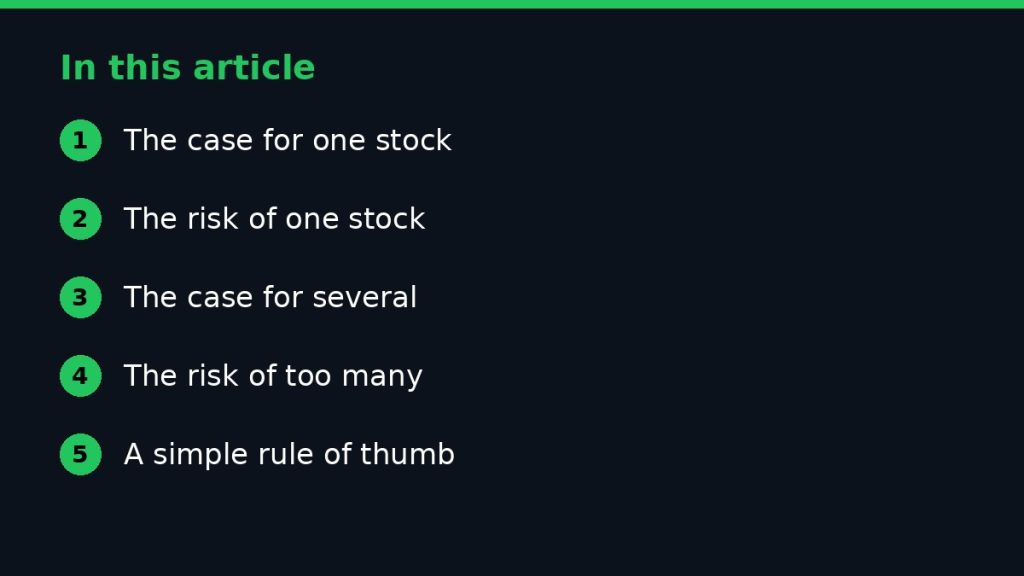
The risk of too many stocks
Ten holdings of ₦5,000 each means ten sets of fees, ten companies to follow, and little effect from any one of them. The 2026 comparison showed a ₦100 minimum commission at one app; on ₦5,000 that is 2% each time. Beginners often confuse owning many things with being diversified, when really they have created a mess.
A simple rule of thumb
- Under ₦20,000: one or two holdings.
- ₦20,000 to ₦100,000: two to four holdings.
- Above ₦100,000: three to six holdings, adding more as the balance grows.
These ranges are guidelines, not rules. The right number depends on your fees and your time to follow companies.
Diversify across sectors, not just names
Three banks are not truly diversified, since they share the same regulator and economic risks. Mix sectors: banks (GTCO, Zenith Bank), telecoms (MTN Nigeria), cement (Dangote Cement, BUA Cement), food (BUA Foods) and energy (Seplat Energy) all paid dividends in 2026, according to Mansa Markets. These are illustrations, not recommendations.
Think about size of each position
Many investors limit one holding to a modest share of the portfolio. For example, with ₦100,000, a cap of ₦30,000 on any one company. Choose a limit and stick to it.
You can start with one and add
You do not need to decide everything on day one. Start with one company, learn the process, and add a second and third when you invest again. This approach keeps early fees low while still moving toward a spread.
Funds as a middle option
Funds that hold many companies can give instant diversification. They come with their own fees and rules, so compare them before choosing. We did not review specific funds here.
A worked comparison
Imagine ₦20,000 split in two ways. In the first, you buy one company, and the price falls 20%, leaving you with about ₦16,000 on paper. In the second, you put ₦10,000 in each of two companies in different sectors; one falls 20% and the other rises 10%, leaving about ₦19,000. The second result is not guaranteed, but it shows how spreading can soften a bad outcome. The price is more fees, which may be only a little for two purchases but grows with each extra holding.
Questions to help you decide
- How much can I invest right now without fees dominating?
- Do I understand each business I plan to buy?
- Could I follow three or four companies each year?
- Would one company’s failure hurt me badly?
It is not a permanent choice
You can start with one holding and widen over time, or trim a position that has grown too large. The number of stocks you own today is not a lifetime decision, so choose what fits your amount now and revisit it as you grow.
What we could not confirm
- The perfect number of holdings, which depends on your situation.
- How any particular share will perform.
Frequently asked questions
Is one stock too risky? It is riskier than several, though it may be practical for a very small amount.
Do more stocks mean more profit? No. They mainly reduce the damage from any single mistake.
How often should I add a new stock? When your balance is large enough that fees do not dominate.
Key takeaways
Start with one or two holdings if your amount is tiny, then grow toward several companies in different sectors. Avoid both extremes: all your money in one share, and so many positions that fees and confusion take over.
Sources checked
- Nairametrics, H1 2026 NGX report, 4 July 2026
- Kobo Terminal, stockbrokers in 2026 comparison; NairaCompare, the true cost of trading stocks
- Mansa Markets, dividends declared in 2026
- Nairametrics, “Why some bank dividends are paused”, 8 May 2026
Educational content only — not financial advice. Income and savings results vary and are never guaranteed. How we write
Enjoyed this story?
Get the best stories delivered weekly.