What Makes Dangote Cement Shares Rise or Fall?
Last checked: 11 October 2026. This article lists factors that analysts and reports link to Dangote Cement’s share price. It cannot explain any particular day’s move. Educational information only, not investment advice. Share prices change every trading day and you can lose money. Figures come from public reports and company filings as of early October 2026, so check current data before you act.
Dangote Cement’s shares rose about 75 percent from the start of 2026 to early October, reached a peak near ₦1,189 in May, fell 10 percent in a single day in June and recovered to above ₦1,000. Why do prices move like this? There is no single answer, and no one can fully explain a price move after the fact, let alone predict one. But several forces repeatedly appear in company reports and market commentary. This article explains them so you can read the news with a clearer head.
1. Earnings and results
A share is a claim on a company’s profit. In the first half of 2026, Dangote Cement reported profit after tax of ₦638.5 billion, up 22.7 percent, with revenue up 21.4 percent to ₦2.51 trillion. Better-than-expected results can lift a price, and disappointments can push it down. In July 2026 BUA Cement’s price rose 4.84 percent after its results were released, showing how quickly a stock can react to numbers.
2. Dividends
A larger dividend can attract buyers who want income. The ₦45 payment for 2025 was 50 percent higher than the year before. Investors then compare the dividend yield, about 4.2 percent at the October price, with alternatives such as bonds and treasury bills.
3. Costs: energy, logistics and inputs
Cement making needs large amounts of fuel and power, and moving cement across Nigeria costs money. One report on the company’s first-half results noted continued pressure from energy and logistics costs, so changes in these costs can affect expected profit.
4. The naira and the economy
An independent analysis noted that earlier revenue growth was boosted by the naira’s fall, while the same fall caused foreign-exchange losses and higher finance costs on borrowings. A more stable currency was credited in 2026 results reports for helping cement makers. Interest rates, inflation, government spending on infrastructure and housing demand also shape the outlook.
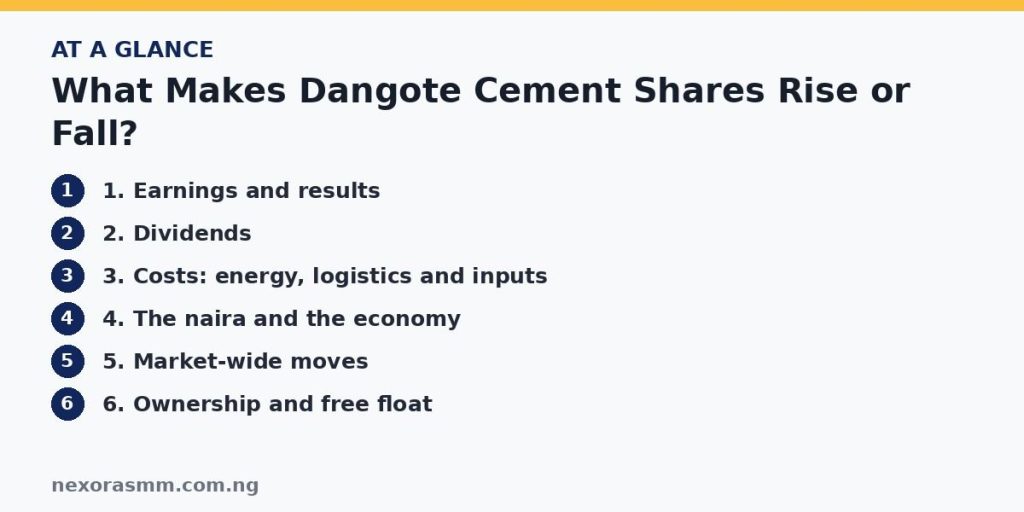
5. Market-wide moves
Dangote Cement is so large that it affects the NGX All-Share Index and is affected by it. Its beta of 1.37, reported by one analyst, means it has tended to move more than the market. When the index surged above 250,000 points in May 2026, the stock climbed with it. When investors take profits across the market, large stocks often fall too.
6. Ownership and free float
Reports say Aliko Dangote holds about 86.8 percent of the shares, and MarketScreener lists the free float at about 11 percent. A small free float can magnify price moves, because relatively few shares are available to trade. Large investor decisions, whether buying or selling, can have an outsized effect.
7. Competition
BUA Cement reported H1 2026 profit after tax up 79.6 percent to ₦324.9 billion, and HBM Nigeria’s rose 57 percent. Strong rivals can take market share or push investors to compare valuations. Our article comparing Dangote Cement and BUA Cement covers this.
8. Company news and expansion
Capacity additions, exports (up 62.3 percent in H1 2026), new plants and the Pan-African business all influence expectations. The Pan-African segment’s EBITDA margin fell to 17.6 percent from 20.1 percent, which analysts watch closely.
9. Sentiment and speculation
Social media, rumours and momentum buying can push prices up, and fear can push them down. A stock that has risen sharply attracts new buyers hoping for more, which can make a fall steeper when sentiment turns.
How to use this
- Follow the quarterly results and dividend notices from the NGX.
- Watch the naira, interest rates and energy costs.
- Use the daily price move as information, not as a reason to trade.
- Be careful with any explanation that sounds certain. Prices reflect many buyers and sellers at once.
What we could not confirm
- Why the price fell 10 percent on 24 June 2026. I found no published explanation.
- How much each factor matters. Analysts disagree, and the weights change over time.
- Future events. Prices respond to news that has not happened yet.
Frequently asked questions
Does a rising cement price raise the share price? It can improve expected profit, but the share price also depends on volumes, costs and what investors already expect.
Can one big investor move the price? In a stock with a small free float, large orders can have a bigger effect than in a widely held stock.
Key takeaways
Dangote Cement’s share price responds to earnings, dividends, costs, the naira, market sentiment, its small free float and competition. These are useful lenses, but they do not make price moves predictable, so invest only what you can leave alone.
Sources checked
- Dangote Cement, H1 2026 unaudited results (NGX filing)
- Proshare, ‘Dangote Cement Plc H1 2026 Results: Record Profit, Higher Margins and a Swing to Positive Net Cash’
- Olalekan Akinola, ‘Dangote Cement: Investment Report’ (September 2026)
- Nairametrics, ‘BUA Cement’s H1 2026 pre-tax profit surges 79 percent’
- Legit.ng, ‘Nigeria’s Top Cement Makers Post Strong H1 2026 Earnings’
- Shore Africa, ‘Aliko Dangote gains N8.4 trillion from Dangote Cement shares’
- Ad-Hoc-News, ‘Dangote Cement stock reports 21.4 percent H1 revenue growth’
Educational content only — not financial advice. Income and savings results vary and are never guaranteed. How we write
Enjoyed this story?
Get the best stories delivered weekly.