Why Petrol Prices Remain a Major Concern for Nigerian Households
Last checked: 14 October 2026. This article uses pump and depot prices reported between 8 and 10 October 2026. Prices change by location and by the day, so check your local station.
For a Nigerian household, petrol is not only the cost of filling a car. It is the cost of the generator that runs the fridge, of the bus fare to work, of the truck that brings food to the market. When petrol rises, the effect spreads. In October 2026 prices are high again, the government is offering temporary relief and the argument over what to do about it is moving into the politics of the 2027 elections. This article sets out where prices stand, why they moved, how households feel it and what is being done.
Where prices stand
Reports from 8 to 10 October 2026 put petrol at about ₦1,355 to ₦1,360 per litre at NNPC stations in Lagos, ₦1,338 at MRS and between ₦1,368 and ₦1,400 at independent stations. In Abuja, several stations moved to about ₦1,405 to ₦1,409. The Nigeria Labour Congress said in late September that petrol was selling at about ₦1,430 in major cities, with some locations charging up to ₦1,500. The Dangote refinery’s ex-gantry price, the wholesale price that many marketers follow, was ₦1,325 per litre on 8 October after a ₦25 cut from ₦1,350. At depots, petrol reached ₦1,370 in Calabar and as high as ₦1,900 at some Port Harcourt depots on 9 and 10 October.
How fast it has risen
The wholesale price rose four times between 20 August and 12 September, from ₦1,165 to ₦1,350. An NNPC outlet on Awolowo Road in Lagos was selling at ₦1,205 in late August. At ₦1,360 in October, the pump price is about 13 percent higher. A household that buys 40 litres a month would pay roughly ₦6,200 more for the same fuel than it did then.
Why prices rose
- Global crude. Brent was reported at about $104.50 a barrel on 10 October 2026, and the Indian basket at more than $121. Dangote Refinery blamed higher crude costs for its September increases.
- Landing cost. Figures from the marketers’ association MEMAN, cited in a market report, put the landing cost at about ₦1,317 per litre on 8 October, up ₦20.
- A deregulated market. Prices follow supply costs and marketers’ decisions, not a fixed subsidised price. The finance minister said even a ₦500 per litre subsidy would cost over ₦16 trillion a year.
- The naira. The official rate was ₦1,331.60 per dollar on 8 October. Crude is priced in dollars, so currency moves matter.
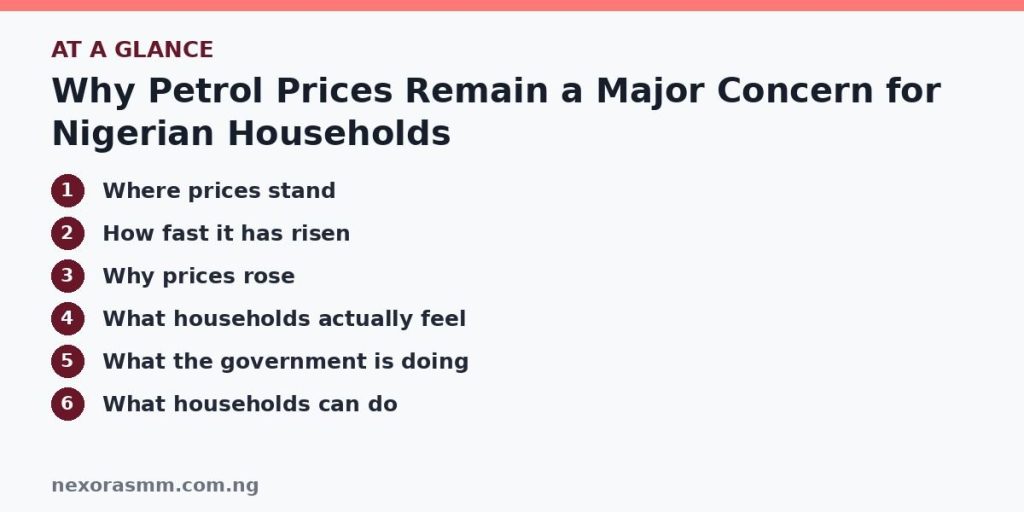
What households actually feel
The direct cost is for people who drive or run generators. The indirect cost reaches everyone. Transport operators raise fares, traders add the cost of delivery, and food and goods become dearer. A report from March 2026, after an earlier jump, said commuters in Lagos and Benin City faced fare increases of more than 30 percent on several routes. Households also cut other spending, such as eating out or visiting family, to protect the fuel budget. Ride-hailing drivers have started an indefinite strike in Lagos partly over the cost of fuel, which can make trips dearer or scarcer.
What the government is doing
On 8 October the finance minister, Taiwo Oyedele, announced a 30-day relief measure at NNPC stations, with NNPC Retail forgoing its retail margin and selling at cost, and public transporters served first. The government said it is negotiating a landing-cost ceiling of ₦1,350 per litre. Reports also describe a ₦66 per litre discount for customers paying through the NNPC app, extended to 31 October. As of 9 October, the size of the discount at the pump and how transporters would be identified had not been published, and prices at some stations rose anyway. Separately, the government promotes compressed natural gas as a cheaper fuel, which we examine in another article.
What households can do
- Compare prices. Differences of ₦40 or more per litre between stations were reported in Lagos.
- Use the relief where it exists. Check the NNPC app if you use NNPC stations, and read the terms.
- Reduce wasted fuel. Combine trips, share rides where you can and service the vehicle or generator so it burns less.
- Build the price into the budget. Plan for fuel prices staying high for some months, and set a monthly limit.
- Avoid panic buying and hoarding. It is risky and can push local prices up.
The wider debate
Prices are now a political issue ahead of the 2027 elections, with unions and opposition politicians criticising the cost of living and the government pointing to relief and to alternatives such as CNG. Households face the same question either way: how long will high prices last? That depends on crude prices, the naira and the supply decisions of the refinery and importers, none of which individuals control.
What we could not confirm
- How much of the relief discount is reaching pumps. The size and mechanics were not published when I checked.
- Where prices will go next. They depend on oil markets and exchange rates.
- Exact prices at your station today. They vary by location and change often.
Frequently asked questions
Why does Dangote’s price matter if I buy at the pump? Many marketers use the refinery’s gantry price as a benchmark, so changes usually reach the pump within days.
Is there a fixed petrol price in Nigeria? No. The market is deregulated, so prices vary by supplier and location.
Key takeaways
Petrol in Lagos is around ₦1,350 to ₦1,400 a litre in October 2026, about 13 percent above late-August levels, driven mainly by high crude prices. Temporary relief at NNPC stations helps only some buyers, so households should compare stations, cut wasted trips and plan for prices to stay high.
Sources checked
- Vanguard, “Petrol: Marketers hike pump price in Abuja, Lagos by N29/litre” (October 2026)
- Vanguard, “Petrol hits N1,900/litre as depot prices surge despite NNPC cut” (10 October 2026)
- Legit.ng, “Petrol Depot Prices Rise to ₦1,370 as FG Announces 30-Day NNPC Relief”
- Legit.ng, “NNPC, Other Filling Stations’ New Petrol Price Puts Fresh Political Battle Ahead of 2027”
- Rio Times, “Nigeria Orders 30-Day Petrol Discount at NNPC Pumps”
- Legit.ng, “Dangote Refinery: MRS, NNPC, Rainoil, Other Filling Stations Release New Petrol Prices”
- Nigerian Observer, “Motorists, commuters groan as petrol price climbs” (March 2026)
Educational content only — not financial advice. Income and savings results vary and are never guaranteed. How we write
Enjoyed this story?
Get the best stories delivered weekly.