How to Write a Short Film Script With AI, Step by Step
An AI assistant can be a useful sparring partner for a screenplay, but it should not be the author. By the end of this guide you will be able to move from a rough idea to a formatted five to eight minute script, using the assistant to generate options, test structure and spot problems while you make the decisions.
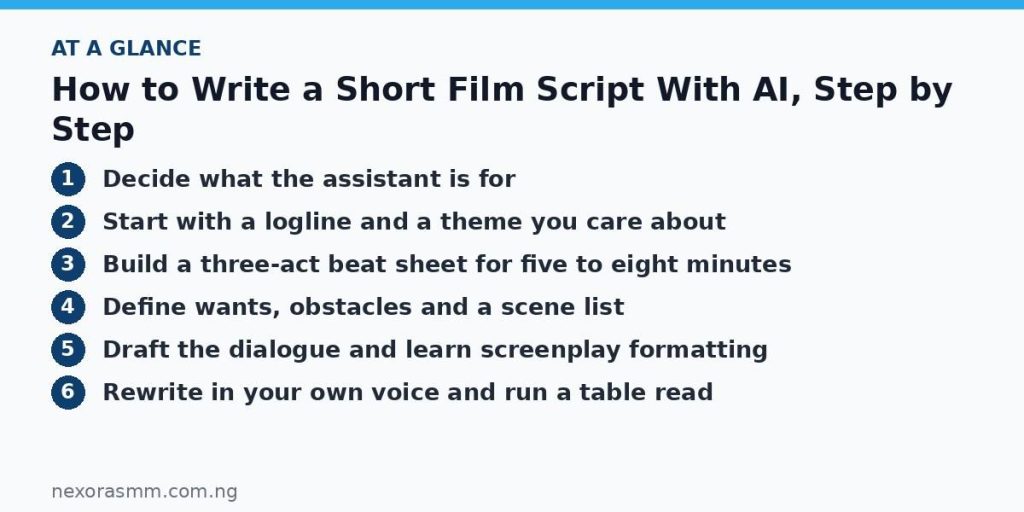
Decide what the assistant is for
Before you type a single prompt, set the rules of the partnership. The assistant is good at producing many options quickly, asking questions you had not thought of, and reformatting text. It is weak at knowing what matters to you, and its default instincts tend toward familiar plots and polite, generic dialogue.
So use it for three jobs: brainstorming alternatives, pressure-testing your choices, and handling mechanical work. Keep for yourself the jobs that define a film: what the story is about, what the characters want, what the ending means and how every line sounds. A script that you did not shape will usually feel flat, and audiences can sense it.
Also check the terms of any writing tool you use, especially if you plan to enter festivals or sell the film. Some competitions have rules about AI-assisted writing, so read them before you submit and be ready to disclose how you worked.
Start with a logline and a theme you care about
A logline is one sentence: a character, a goal, an obstacle and stakes. Write your own first version even if it is clumsy. Then ask the assistant to challenge it.
Example prompt: Here is my logline: a night-shift bus conductor in Accra finds a wallet containing a stranger’s last savings and has until dawn to return it before his own rent is due. Ask me ten questions that would make this story more specific and more emotionally risky. Do not write the story.
Answering those questions in your own words does more for the script than any generated paragraph. Notice which answers excite you. That excitement points to your theme. Then ask for five alternative loglines in different genres so you can see what your idea could become, and choose, combine or ignore them.
Keep the scope small. A five to eight minute film can hold one main character, one central problem, two or three locations and a handful of speaking roles. If your logline needs a war or a city-wide chase, shrink it to the single moment that matters.
Build a three-act beat sheet for five to eight minutes
At this length, think in rough proportions. Act one sets up the person and the problem in the first minute or two. Act two is the longest, where the character tries things and the pressure rises. Act three delivers the decision and the consequence in the last minute or two. A page of screenplay is commonly estimated at about a minute of screen time, so you are aiming for roughly five to eight pages.
Write your beats as short lines: opening image, problem appears, first attempt fails, complication, lowest moment, choice, ending image. Fill them in yourself, then ask the assistant to look for weak points.
Example prompt: Below is my seven-beat outline for a short drama set in a Nairobi matatu stage. Point out any beat where the stakes do not rise, any coincidence that feels convenient, and any moment where the character is passive. Offer two possible fixes for each, without rewriting my beats.
Choose the fixes that suit you, or invent a better one. A useful rule is that the ending should be a choice made by the main character, not something that happens to them.
Define wants, obstacles and a scene list
Every main character needs a surface want (return the wallet) and often a deeper need (to be someone who can still be honest when it costs him). Obstacles should test that need. Write one short paragraph per character: what they want, what stands in the way, what they will not admit, and how they speak. A mother in a Kano compound may speak in clipped, practical sentences, while her son code-switches between English and Hausa when he is nervous. Details like these make dialogue feel specific.
Now convert your beats into a scene list. Each scene gets one line with a location, time of day, who is present and what changes. If nothing changes in a scene, cut it or merge it. Ask the assistant to check this.
Example prompt: Here is my scene list. For each scene, tell me in one sentence what changes for the main character. Flag any scene where your answer is nothing or very little.
Once your scenes are locked, you can begin visual planning. The later process of turning scenes into frames is covered in storyboarding with AI from script to shot list.
Draft the dialogue and learn screenplay formatting
Write the first draft of each scene yourself, even if it is rough. Use the assistant afterward to explore alternatives, for instance asking for three versions of a single exchange with different emotional undercurrents, such as one where the speakers avoid the real topic. Treat those versions as raw material, not finished lines.
Learn the basics of screenplay format, because it keeps your script readable and your timing predictable.
- Scene heading: INT. or EXT., location, time of day, in capitals.
- Action: present tense, short paragraphs, only what can be seen or heard.
- Character name: capitalised above their dialogue.
- Dialogue: the spoken words, with minimal parentheticals.
An assistant is helpful for converting your plain-text draft into this layout, but proofread the result. It sometimes changes wording without telling you. Remember too that a film with AI-generated visuals depends on what a generator can show, so describe action clearly and avoid long internal thoughts that cannot appear on screen. Learning to describe a scene visually is also the basis of good prompts, as shown in how to write AI prompts for cinematic movie scenes.
Rewrite in your own voice and run a table read
The rewrite is where the script becomes yours. Read each line aloud and ask whether this person would really say it. Replace generic phrases with words your characters would use, including proverbs, slang and rhythms from the place you are writing about. If you write about a community you do not belong to, ask someone from it to read the script and correct what rings false.
Cut anything that explains what the audience can already see. Look for lines where characters announce their feelings and replace them with action or silence.
Then hold a table read. Ask friends to voice the roles while you listen and time it. Note where people laugh, shift in their seats or lose attention. Mark each problem spot, revise, and repeat once. When you are done, keep a record of which parts used assistant suggestions so that you can describe your process honestly if you are ever asked.
Key takeaways
- Use the assistant to ask questions, offer options and test structure, and keep every final decision for yourself.
- Write your own logline and beats first, then ask for critique rather than replacement.
- Keep the scope small enough for five to eight pages, and make sure every scene changes something.
- Rewrite dialogue aloud in your characters’ real voices and test it with a table read.
Educational content only — not financial advice. Income and savings results vary and are never guaranteed. How we write
Enjoyed this story?
Get the best stories delivered weekly.