How to Backtest a Trading Strategy Without Fooling Yourself
Last checked: 11 October 2026. This guide explains common backtesting errors and a safer process. A good backtest reduces uncertainty; it never proves future profit. Educational content only, not financial advice. Trading leveraged products such as forex and CFDs carries a high risk of loss. European regulators have reported that 74 to 89 percent of retail CFD accounts lose money, and past results never guarantee future results.
Backtesting means applying a set of trading rules to historical prices to see how they would have performed. It is one of the most valuable tools a trader has, and one of the easiest to misuse. It is simple to build a backtest that looks wonderful and fails the moment real money is involved, because the test quietly used information or assumptions that real trading does not allow. This guide explains the main traps, a step-by-step process that reduces them and the checks that tell you whether to trust the result.
What a backtest can and cannot tell you
It can show whether your rules produce consistent signals, give rough expectations for win rate, average trade and drawdown, and show how the system behaves in trending and ranging conditions. It cannot tell you future performance. Real markets add slippage, partial fills and latency, and the future may not look like the sample.
The traps that make results look better than they are
- Overfitting (curve fitting). Adjusting the rules until they match past noise instead of a repeatable pattern. One practical guide says that if you optimise 15 parameters to match three months of data, you have found a curve fit, not a strategy. Rules with two or three inputs that work across several instruments and timeframes are more trustworthy.
- Look-ahead bias. Using information that would not have been available at the time of the trade, such as acting on a candle’s high or low before the candle closed.
- Survivorship bias. Testing only on instruments that still exist today. It matters most for shares and funds, but it also matters when you pick the pairs or symbols that happened to behave well.
- Ignoring costs. Spreads, commissions, swaps and slippage. One guide gives an example of a strategy that makes $2 per trade before costs but pays $3 per round trip, which is a loser.
- Data snooping and selection bias. Testing many variants and reporting only the best. If you test fifty versions, one will look good by chance.
- Too little data. A system that looks great over 30 trades is statistically meaningless.
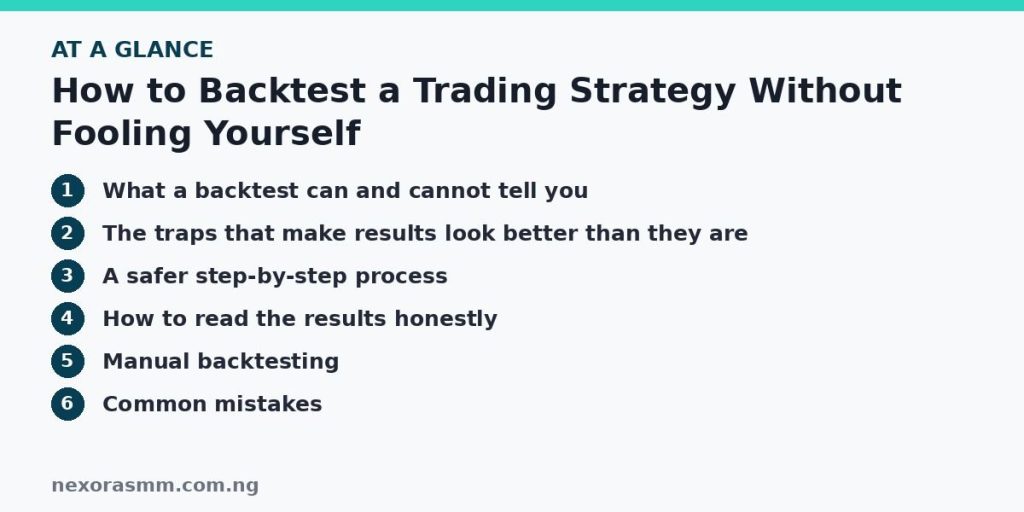
A safer step-by-step process
- Write the hypothesis and the rules first. For example: “In an uptrend, buying pullbacks to a support zone with a rejection candle produces positive expectancy.” Define entry, stop, target and position size exactly.
- Fix the rules before you look at results. Limit the number of adjustable parameters.
- Split the data. Use an in-sample period to develop the rules and a separate out-of-sample period you have never looked at to test them.
- Include realistic costs. Use actual spreads for your broker and allow for slippage, especially around news.
- Record every trade, not only the summary. Measure win rate, average win and loss, expectancy in R, maximum drawdown and the longest losing streak.
- Check robustness. Change a parameter slightly. If results collapse, the edge was fragile. Test on other pairs and timeframes.
- Walk forward. Optimise on one window, test on the next, then roll forward and repeat. This mimics how you would use the rules in real time.
- Forward test on a demo account for a meaningful period. One guide suggests at least one to two weeks of real-time simulation to catch issues that backtesting cannot, such as timing and data differences. Longer is better for a swing strategy that trades rarely.
- Start live with small size and compare real results with the test.
How to read the results honestly
- Expectancy after costs matters more than total profit.
- Maximum drawdown tells you whether you could stand to trade the system. A system that returns 40 percent with a 35 percent drawdown may be impossible to follow.
- Number of trades. More is better, and results from a handful are noise.
- Distribution. Check whether one lucky month or one huge trade creates all the profit.
- Performance in different regimes. Look at trending and ranging periods separately.
Manual backtesting
You can backtest by hand: scroll a chart to a past date, hide the future, and record each trade your rules would have taken. This is slow but teaches you the setup. The danger is peeking: you have already seen the chart, so your memory of what happened can influence your decisions. Use a replay tool or cover the right side of the chart, and log every trade, including the ones you did not like.
Common mistakes
- Treating a backtest as proof.
- Stopping the test when results look good and continuing when they do not.
- Re-optimising until the equity curve is smooth.
- Using the whole data set to optimise and then calling it out-of-sample.
- Skipping the forward test because the backtest was convincing.
What this article cannot tell you
- How much your future live results will differ from the backtest. They almost always differ, and costs and execution are the usual reasons.
- How many trades are needed. Sources give different minimums and it depends on your strategy’s variability.
- Whether your data is accurate. Free historical data can have gaps and unrealistic spreads, and you should check it.
Frequently asked questions
What is walk-forward analysis? It repeatedly optimises on one period and tests on the next unseen period, then rolls forward, to check that the rules hold up on new data.
Is demo testing the same as live? No. Demo fills are cleaner and there is no emotional pressure, but demo testing still catches timing and rule errors.
How many parameters are too many? Guides suggest fewer is better. Two or three that work across instruments are more trustworthy than ten tuned to one chart.
Key takeaways
A backtest is useful only if you guard against overfitting, look-ahead bias, survivorship bias and ignored costs. Fix the rules first, hold back unseen data, include realistic spreads, test robustness, walk forward, forward test on a demo account and start live small.
Sources checked
- Capital.com, “Backtesting a trading strategy: how it works”
- Hedge Fund Alpha, article on backtesting pitfalls (look-ahead, survivorship, overfitting, multiple testing)
- CrossTrade, “Backtesting Best Practices”
- ABC Trading Group, “8 Backtesting Pitfalls That Ruin Your Trading Strategies”
- Gainium, “Common Backtesting Problems”
Educational content only — not financial advice. Income and savings results vary and are never guaranteed. How we write
Enjoyed this story?
Get the best stories delivered weekly.