Why Traders Lose Money: Overtrading, Oversizing and Poor Risk Management
Last checked: 11 October 2026. This guide draws on regulator statistics and trading education to explain common causes of losses. It describes patterns, not any individual’s circumstances. Educational content only, not financial advice. Trading leveraged products such as forex and CFDs carries a high risk of loss. European regulators have reported that 74 to 89 percent of retail CFD accounts lose money, and past results never guarantee future results.
Most people who try retail forex or CFD trading lose money. That is not a motivational slogan; it is what regulators found when they examined broker data. Understanding why is more useful than hoping to be the exception, because the causes are mostly about behaviour and risk, not about missing a secret indicator. This guide explains the numbers, the three habits that cause most damage (overtrading, oversizing and weak risk management) and a set of rules that reduce the chance of blowing an account.
What the data says
When the European Securities and Markets Authority restricted CFDs for retail clients in 2018, it reported that national regulators’ analyses showed 74 to 89 percent of retail accounts typically lose money, with average losses per client between 1,600 and 29,000 euros. It said the products’ complexity and excessive leverage had caused significant losses. Other education sites cite similar ranges. These figures concern CFD accounts at European brokers in a particular period, so they are not a forecast for you, but they are the most credible public evidence about outcomes for typical retail clients. Nigeria’s draft forex rules, published in September 2026, would require brokers to disclose the percentage of retail accounts that lose money each month.
Cause 1: Oversizing
Position size is the biggest lever on risk, and beginners tend to pull it too hard. Consider ten losing trades in a row, which happens even to decent systems:
- Risking 1 percent per trade: the account falls by roughly 10 percent, to about $904 from $1,000.
- Risking 2 percent per trade: about $817 remains.
- Risking 10 percent per trade: about $349 remains, and you need a gain of about 187 percent to return to $1,000.
Losses are also harder to recover than they look. A 20 percent drawdown needs a 25 percent gain to recover, a 30 percent drawdown needs about 43 percent and a 50 percent drawdown needs 100 percent. High leverage makes it easy to open an oversized position, which is why many accounts end after a few bad trades. Our lot size guide shows how to size from a stop and a fixed risk.
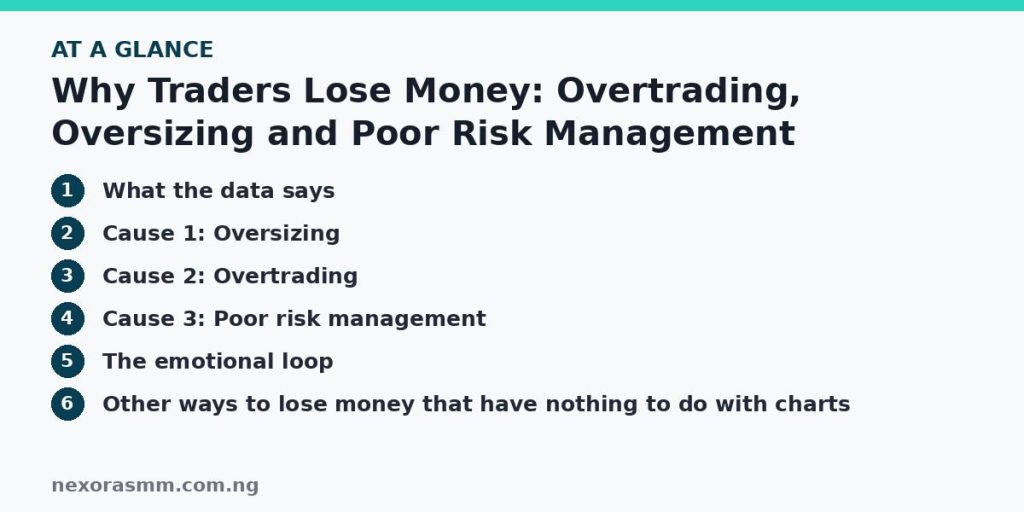
Cause 2: Overtrading
Overtrading means taking more trades than the plan justifies. Typical triggers are boredom, a wish to recover a loss, fear of missing a move or the idea that a trader must be in the market to earn. Each trade carries spread and sometimes commission, so more trades means more guaranteed cost. Overtrading also lowers the average quality of setups, because you accept second-best conditions. A written daily limit on trades and a maximum daily loss, for example stopping after two losing trades or after a loss of 2 or 3 percent, protect against the worst days.
Cause 3: Poor risk management
This covers several errors:
- No stop loss, or a stop moved further away when the trade turns against you.
- Risking different amounts on each trade, usually more after a win and more after a loss.
- Stacking correlated trades that all depend on the same view of the US dollar.
- Averaging down, adding to a losing position, which increases exposure when you are most likely wrong.
- Trading through major news with a small stop and a large position.
The emotional loop
Journal-based education often highlights a repeating pattern: a loss leads to frustration, frustration to a revenge trade, the revenge trade to a larger loss and then to a decision to take even more risk. A trader who has gone through several losing sequences in a row is more likely to break their own rules. The remedy is rules written in advance, daily loss limits that end the session and a journal that records emotional state next to results. Our guide on keeping a trading journal explains the process.
Other ways to lose money that have nothing to do with charts
- Unregulated brokers. Nigeria’s SEC says unregistered online forex platforms are illegal under the 2025 Act. Check a broker’s status before depositing, and test withdrawals.
- Signal sellers and “account managers”. Anyone promising fixed returns or asking you to hand over account access is a red flag; see our guide on checking SEC registration.
- Bonuses with trading-volume conditions. They can push you to overtrade.
A rule set that reduces the damage
- Risk a small, fixed percentage of the account per trade.
- Always place the stop at a logical level when you enter, and never widen it.
- Set a maximum number of trades and a maximum daily loss, and stop when either is reached.
- Limit total open risk across all positions.
- Trade only the setups written in your plan.
- Review your journal every week.
What this article cannot tell you
- Whether you will lose money. The regulator statistics describe groups of accounts, not individuals.
- Whether the ESMA figures apply to Nigerian brokers or to today’s market. They come from a 2018 analysis of EU retail CFD accounts.
- How much risk is right for you. Common guidelines suggest 1 to 2 percent per trade, but that is a guideline, not advice.
Frequently asked questions
Is it possible to be consistently profitable? Some traders are, but the evidence shows most retail accounts lose. Treat profit as something you must demonstrate with records over a large sample.
Is a small account safer? Smaller absolute losses are easier to bear, but a small account can still be ruined by oversized positions.
What should I do after a big loss? Stop trading for the day, review the trade against your plan and return only when you can follow your risk rules.
Key takeaways
Most retail accounts lose money, mainly because of oversized positions, too many trades and weak risk rules, not because of a missing indicator. Fix the risk per trade, limit the number of trades and the daily loss, avoid unregulated brokers and keep records so your rules are tested against your behaviour.
Sources checked
- European Securities and Markets Authority, announcement on binary options and CFD restrictions
- FXStreet, “Why do most retail traders fail, and what can I do to improve my chances of success?” (March 2025)
- Nairametrics and Guardian Nigeria, reports on the SEC’s draft forex rules (September 2026)
- TradeZella, trading journal and weekly review guides (emotional patterns)
- Drawdown and compounding figures are my own calculations from the stated percentages
Educational content only — not financial advice. Income and savings results vary and are never guaranteed. How we write
Enjoyed this story?
Get the best stories delivered weekly.