An AI Writing Workflow That Keeps Your Content Original and Accurate

Writing with AI can save hours, but it is easy to produce bland, repetitive articles that readers abandon and search engines ignore. The difference between helpful content and forgettable filler is the process you wrap around the tool. This article shares a practical workflow that keeps your writing accurate, original and useful.
Why quality matters more than speed
Search engines and ad networks both aim to reward content that helps people. Pages that repeat the same generic points found everywhere else give readers little reason to stay. If your goal is to build a site that earns, original thinking and real usefulness are your long-term advantage, not the number of articles you can publish in a day.
Step 1: Start with the reader, not the tool
Before opening any assistant, write three lines: who is this for, what problem are they trying to solve, and what should they be able to do after reading? A clear purpose prevents rambling and gives you a standard to judge the draft against.
Step 2: Do your own research
Collect two or three reliable sources, such as official websites, reputable publications or your own experience. Note the key facts and the source of each. This protects you from the common problem of invented statistics and gives you material no generic prompt can supply.
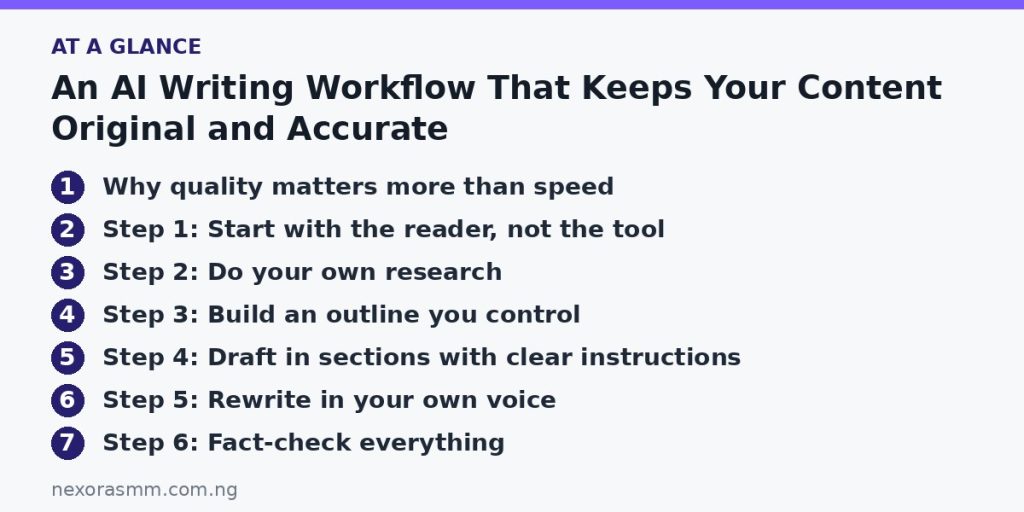
Step 3: Build an outline you control
Ask the AI for outline suggestions if you wish, but make the final structure yours. Good outlines include a short introduction that states the promise, headings that match real questions, and a closing section that tells the reader what to do next. Remove any section that does not serve your reader’s goal.
Step 4: Draft in sections with clear instructions
Instead of asking for a whole article in one go, request one section at a time. Provide the facts you collected, the tone you want and the length. Ask the tool to avoid clichés and to use plain language. Shorter requests usually give more focused results.
Step 5: Rewrite in your own voice
This is the step that separates good content from filler. Read the draft aloud and change anything that sounds stiff or vague. Add a personal example, a lesson learned or a local detail. Replace general claims with specific ones. If you cannot add anything of your own to a paragraph, ask whether it deserves to be there.
Step 6: Fact-check everything
AI tools may produce confident but incorrect statements. Check each name, date, number and claim against your sources. Remove anything you cannot confirm. Never publish medical, legal or financial claims without checking them carefully and, where appropriate, advising readers to consult a qualified professional.
Step 7: Improve readability
- Use short paragraphs of two to four sentences.
- Write headings that describe the content clearly.
- Use lists for steps and options.
- Add images that actually explain something, with descriptive alt text.
- Link to other useful pages on your own site and to trusted outside sources.
Step 8: Add a human check before publishing
Before you press publish, ask: Would I be comfortable if a client, teacher or friend read this under my name? Does it contain anything copied or too close to another source? Is the information up to date? Run a plagiarism check if you have any doubt, and keep a note of the sources you used.
Mistakes to avoid
- Publishing raw output. Unedited text usually sounds the same as thousands of other pages.
- Stuffing keywords. Write for people first; use natural phrases that match what readers search for.
- Publishing too many thin pages. Ten strong articles help more than a hundred weak ones.
- Ignoring updates. Review older posts every few months and correct anything that has changed.
A simple checklist before you publish
- Does the opening paragraph tell the reader what they will learn?
- Is every number or claim supported by a source you trust?
- Have you added at least one example, story or practical tip that is your own?
- Do the title and headings accurately describe the content?
- Do images have clear alt text and relate to the topic?
Keep this list beside your editor and tick it off every time. It takes five minutes and prevents most quality problems.
Frequently asked questions
Can Google detect AI content? Search engines focus on whether content is helpful and original, not only on how it was produced. Low-value, repetitive pages perform poorly regardless of who or what wrote them. Careful editing and real insight matter more than trying to hide tool use.
How long should an article be? As long as it needs to be to answer the question completely. Many useful guides run between 800 and 1,500 words, but length alone does not create quality.
Should I tell readers I use AI? Honesty builds trust. A short note in your editorial policy explaining how you use tools and how you check facts is a good practice.
What if the AI keeps producing the same style? Give more specific instructions, supply your own examples of the tone you want, and edit heavily. Your own experiences are the best fix for generic prose.
Key takeaways
Start with the reader, gather your own sources, control the outline, draft section by section, rewrite in your voice and check every fact. A repeatable process lets you use AI to save time without lowering the quality of what you publish.
Educational content only — not financial advice. Income and savings results vary and are never guaranteed. How we write
Enjoyed this story?
Get the best stories delivered weekly.