Forex Trading for Beginners: How the Market Works Before You Risk Real Money
Last checked: 11 October 2026. This guide explains how the forex market is organised before any money is at risk. It is a learning guide, not a recommendation to trade. Educational content only, not financial advice. Trading leveraged products such as forex and CFDs carries a high risk of loss. European regulators have reported that 74 to 89 percent of retail CFD accounts lose money, and past results never guarantee future results.
Forex, short for foreign exchange, is the market where one currency is exchanged for another. Every time a company pays a foreign supplier, a traveller changes money or a bank moves funds across borders, it takes part. Individuals can also speculate on price changes through online brokers. That second group is who this guide is for, and the first lesson is the most important: understanding how the market works is not the same as being able to profit from it. This article explains the structure, the vocabulary and the risks, and ends with a plan for learning before you risk real money.
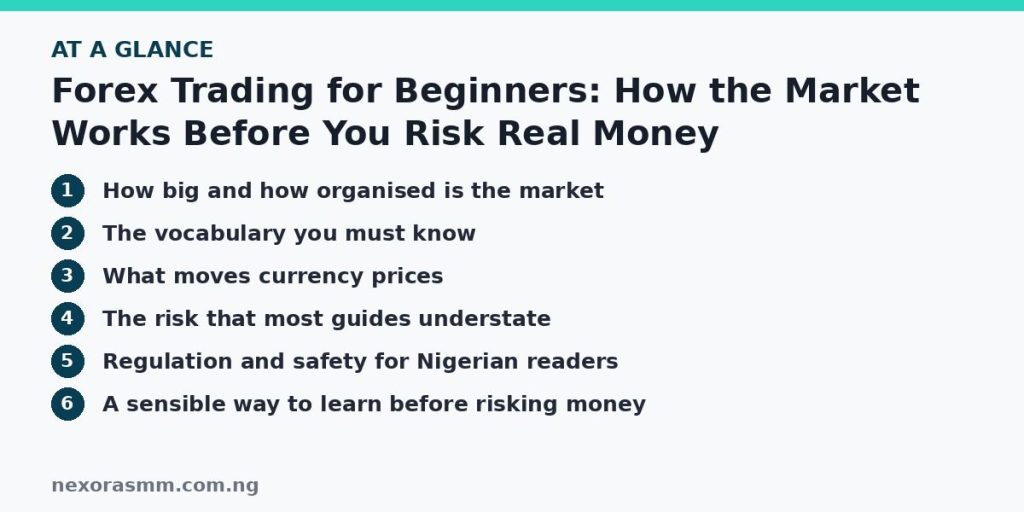
How big and how organised is the market
The Bank for International Settlements reported that global foreign exchange trading averaged $9.6 trillion per day in April 2025, up 28 percent from 2022. The US dollar was on one side of 89 percent of all trades, and four locations (the United Kingdom, the United States, Singapore and Hong Kong) accounted for 75 percent of trading. Most of that turnover is not retail speculation. FX swaps were the largest instrument at about $4 trillion a day, and the Reserve Bank of Australia’s summary of the same survey notes that spot trades make up about 31 percent of global turnover. Banks, funds, companies and central banks dominate; an individual trader is a very small participant.
The market is also over the counter. There is no single exchange. Prices come from banks and liquidity providers, and your broker passes you a quote. That is why different brokers show slightly different prices and spreads.
The vocabulary you must know
- Currency pair. EUR/USD shows how many US dollars one euro costs. The first currency is the base and the second is the quote.
- Pip. The standard smallest price move for most pairs is 0.0001, or 0.01 for yen pairs.
- Spread. The difference between the buying price and the selling price. It is a cost you pay on every trade.
- Lot. The trade size. A standard lot is 100,000 units of the base currency, a mini lot is 10,000 and a micro lot is 1,000. Our guide on calculating lot size shows how to choose one.
- Leverage and margin. Leverage lets you control a large position with a small deposit, called margin. It magnifies profits and losses equally.
- Stop loss and take profit. Orders that close a trade at a chosen loss or a chosen gain.
What moves currency prices
Interest rate expectations, inflation data, employment reports, central bank statements, trade flows and political events all affect currencies. Scheduled releases can move prices sharply within seconds and widen spreads at the same moment. Beginners often learn this the hard way when a position is open during a major announcement. A basic habit is to check an economic calendar before every session.
The risk that most guides understate
The European Securities and Markets Authority analysed retail CFD accounts across several EU countries and reported that 74 to 89 percent typically lose money, with average losses per client between 1,600 and 29,000 euros. It introduced leverage limits, including 30:1 for major currency pairs, because high leverage had led to heavy retail losses. Some offshore brokers advertise 1:500 or more, which means a very small price move can remove an account. Leverage is not a way to make a small account big; it is a way to lose a small account quickly.
Regulation and safety for Nigerian readers
Nigeria’s Securities and Exchange Commission has said that operating an unregistered online forex or digital asset platform is illegal under the Investments and Securities Act 2025. On 1 September 2026 it published draft rules on online forex and CFD trading. Reports on the draft say it would require brokers and platform providers that serve Nigerians to register, keep client money in segregated accounts, provide negative balance protection, prohibit binary options for retail clients, disclose the percentage of losing retail accounts and submit influencer promotions for approval. The SEC noted that these are proposals and not yet in force, so read the final rules when they are published. In the meantime, check any broker’s regulatory status on the regulator’s own website, avoid anyone who promises fixed returns or sells “signals”, and use our guide on checking SEC registration.
A sensible way to learn before risking money
- Learn the vocabulary and the cost structure. Know what a spread, a swap and a commission are before you open a chart.
- Open a demo account. Practise placing orders, setting stops and reading charts with no money at risk. Remember that demo fills are cleaner than live fills.
- Write a trading plan. Decide your market, your timeframe, your entry rule, your stop loss and your exit rule in advance.
- Set a risk limit per trade. Many educators suggest 1 to 2 percent of the account, which our lot size article explains.
- Keep a journal from the first demo trade. Records show whether you follow your own rules.
- Start small and only with money you can afford to lose. Treat the first live months as paid education.
Common beginner mistakes
- Using the maximum leverage a broker allows.
- Trading without a stop loss, or moving it further away when the trade goes wrong.
- Following a social media “signal” without understanding the reasoning.
- Trading every day because the market is open, instead of waiting for the plan’s conditions.
- Depositing money before testing the broker’s withdrawals.
What this article cannot tell you
- Whether any particular broker or platform is registered or safe for you. Check the regulator’s current register yourself.
- Whether the SEC’s draft forex rules will be adopted unchanged. They were described as proposals when I checked.
- How much you could earn. No source I found gives a reliable figure for beginners, and regulators’ data point to losses for most retail accounts.
Frequently asked questions
Is forex trading gambling? It can become gambling if you trade without a tested plan, with oversized positions. A rule-based approach with controlled risk is different, but profit is never guaranteed.
How much money do I need to start? There is no safe minimum. Many brokers allow small accounts, but small accounts make correct position sizing harder, so learn on a demo first.
Is forex legal in Nigeria? Operating an unregistered forex platform is described by the SEC as illegal under the 2025 Act, and new rules for brokers were proposed in September 2026. Check the current position before you deposit.
Key takeaways
The forex market is huge, decentralised and dominated by institutions. Retail traders use leverage that magnifies losses, and regulators report that most retail CFD accounts lose money. Learn the vocabulary, practise on a demo account, write a plan with fixed risk and check the regulatory status of any broker before sending money.
Sources checked
- Bank for International Settlements, press release on the 2025 Triennial Survey (30 September 2025)
- Reserve Bank of Australia, summary tables of the 2025 BIS Triennial Survey
- European Securities and Markets Authority, announcement on binary options and CFD restrictions
- Nairametrics, “SEC proposes N3 billion minimum capital for forex brokers, N5 billion for trading platforms” (2 September 2026)
- Guardian Nigeria and Leadership, reports on the SEC’s draft Rules on Online Forex Trading and CFDs (September 2026)
- FXStreet, “Why do most retail traders fail?” (March 2025)
Educational content only — not financial advice. Income and savings results vary and are never guaranteed. How we write
Enjoyed this story?
Get the best stories delivered weekly.