How to Build a Trading Plan With Clear Entry, Stop Loss and Exit Rules

Last checked: 11 October 2026. This guide gives a structure for a written trading plan. The example values are placeholders to adapt and test, not recommended settings. Educational content only, not financial advice. Trading leveraged products such as forex and CFDs carries a high risk of loss. European regulators have reported that 74 to 89 percent of retail CFD accounts lose money, and past results never guarantee future results.
A trading plan is a written set of rules that tells you what to trade, when to enter, where to place the stop, when to exit and how much to risk, before the market starts moving. Its job is to replace in-the-moment decisions, which are easily bent by fear and greed, with decisions made calmly in advance. A plan does not make a strategy profitable. It makes your behaviour measurable, which is the only way to learn whether the strategy has any edge. This guide gives a practical structure, a filled-in example and a way to test the plan before real money is involved.
The ten parts of a useful plan
- Purpose and limits. Why you trade, how much capital you will risk in total and the point at which you stop and reassess, for example a maximum drawdown.
- Markets and sessions. The few pairs you trade and the hours you will be at the screen. Fewer markets mean better knowledge of how each behaves.
- Timeframes. One higher timeframe for direction and one lower timeframe for entries.
- Market condition filter. How you decide that the market is trending or ranging, and which setups are allowed in each state. See our article on trending and ranging markets.
- Setup definition. The exact conditions that must be present, written so that a stranger could mark them on a chart.
- Entry rule. The trigger, such as a candle close above a level or a rejection candle at a zone, and the order type.
- Stop loss rule. Where it goes, based on market structure, and the condition that cancels the trade.
- Exit rules. The take-profit target, any partial exits, any trailing method and what to do if price stalls.
- Risk and position sizing. The percentage risked per trade, a limit on total open risk and the lot size formula. See our lot size guide.
- Review routine. What you record in your journal and when you review it.
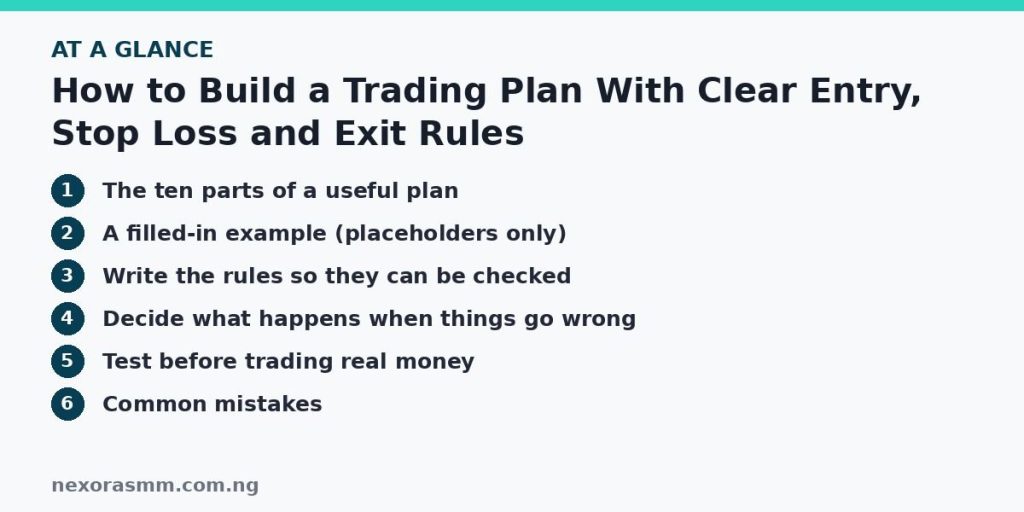
A filled-in example (placeholders only)
- Market and session: EUR/USD and GBP/USD, London session only.
- Timeframes: four-hour for structure, 15-minute for entries.
- Filter: trade only in the direction of four-hour structure (higher highs and higher lows for longs). No trades if structure is a range.
- Setup: in an uptrend, price pulls back into a marked support zone.
- Entry: buy after a 15-minute candle closes back above the zone’s upper edge with a rejection wick.
- Stop: 5 pips below the lowest wick of the zone test.
- Target: the previous swing high, and only if the reward is at least 1.5 times the risk after the spread.
- Risk: 1 percent per trade, no more than two open trades, no more than 2 percent total open risk.
- Daily limit: stop for the day after two losses or three trades.
- News rule: no new entries 30 minutes before or after high-impact releases.
These are examples to show the level of detail. Whether any combination has an edge is unknown until you test it.
Write the rules so they can be checked
Vague rules such as “enter when it looks strong” cannot be tested or followed. Compare “buy on a strong candle” with “buy when a 15-minute candle closes above the zone’s upper edge and the candle body is at least half of its range”. The second version can be marked on a chart, counted in a journal and tested on history. If you cannot define it, you cannot measure it.
Decide what happens when things go wrong
A good plan includes a section for failure: a daily loss limit, a weekly loss limit, an instruction to stop trading after a set number of consecutive losses and a rule that you will not change the plan during a trading session. Changes happen only in your scheduled review, using recorded results and not a single loss.
Test before trading real money
- Backtest on history with realistic costs. Beware of biases that flatter results; our article on backtesting covers them.
- Forward test on a demo account for a meaningful number of trades.
- Trade small live and compare your results with the tests.
Each stage should record whether you followed the plan. A losing trade taken by the rules is acceptable. A winning trade taken against the rules is a problem, because it rewards behaviour you do not want.
Common mistakes
- A plan that exists only in your head.
- Too many setups, so the plan cannot be tested in a reasonable time.
- Changing the stop or target after entry.
- Rewriting the plan after every losing trade.
- Copying a plan from social media without understanding why each rule is there.
What this article cannot tell you
- Whether the example rules would be profitable. They are illustrations of structure and detail.
- How many trades are enough for a meaningful test. Educators give different figures, and it depends on how variable your results are.
- A single correct plan format. Any format works if it is specific, testable and followed.
Frequently asked questions
How long should a trading plan be? As short as possible while remaining specific. One to two pages is common.
Should the plan include indicators? Only if you can state exactly how they change a decision. Otherwise they add clutter.
When should I change the plan? At scheduled reviews, using a large enough sample of recorded trades, not after one or two losses.
Key takeaways
A trading plan covers markets, timeframes, filters, setups, entries, stops, exits, position size, daily limits and review. Write each rule so that it can be checked, test it with costs, trade small and change it only at scheduled reviews.
Sources checked
- VT Markets, “How to Review Your Trades And Actually Improve”
- CrossTrade, “Backtesting Best Practices”
- TradeZella, “The Weekly Trade Review Process That Actually Improves Your Trading”
- CMC Markets and FXEmpire, position sizing guides
- TradingView educational posts on trading journals and performance optimisation
Educational content only — not financial advice. Income and savings results vary and are never guaranteed. How we write
Enjoyed this story?
Get the best stories delivered weekly.