How to Check Whether a Website Is Legitimate Before Paying
Last checked: 10 October 2026. This guide describes checks that reduce risk. No check proves a seller is honest, and scammers copy real details, so combine several checks and pay in ways that give you protection.
Online shops that vanish after taking your money are a daily reality, and a professional-looking website proves nothing, because anyone can build one in an afternoon. The good news is that fake sites usually fail several simple checks at once. This guide gives you a twelve-point routine you can run in about ten minutes before you pay, including a Nigeria-specific step that scammers frequently abuse: fake company registration numbers.
Check 1: Look at the address carefully
Read the web address letter by letter. Scam sites often add extra words, swap letters or use odd endings to imitate real brands. Type the brand’s known address yourself instead of following a link from an advert or message.
Check 2: Do not trust the padlock
The padlock only means the connection is encrypted. Fake shops also have it. It does not say anything about whether the seller will send your goods.
Check 3: Find out how old the domain is
Free domain lookup tools show when a domain was registered. A shop claiming years of trading on a site registered a few weeks ago is a red flag. Hidden owner details are common and not proof of fraud on their own, but they add to the picture.
Check 4: Verify the company, not just the name
Nigeria’s Corporate Affairs Commission warned the public about 15 companies that displayed registration numbers while not appearing in its official database, as BusinessDay reported. The Commission advised everyone to check names and numbers directly on its portal. So do not accept an RC or BN number printed on a website at face value. Open the CAC’s official public search yourself, search the name and number, and confirm that the business exists, the name matches and the status is active. Remember that a listing only proves registration, not good behaviour, so keep going through the other checks.
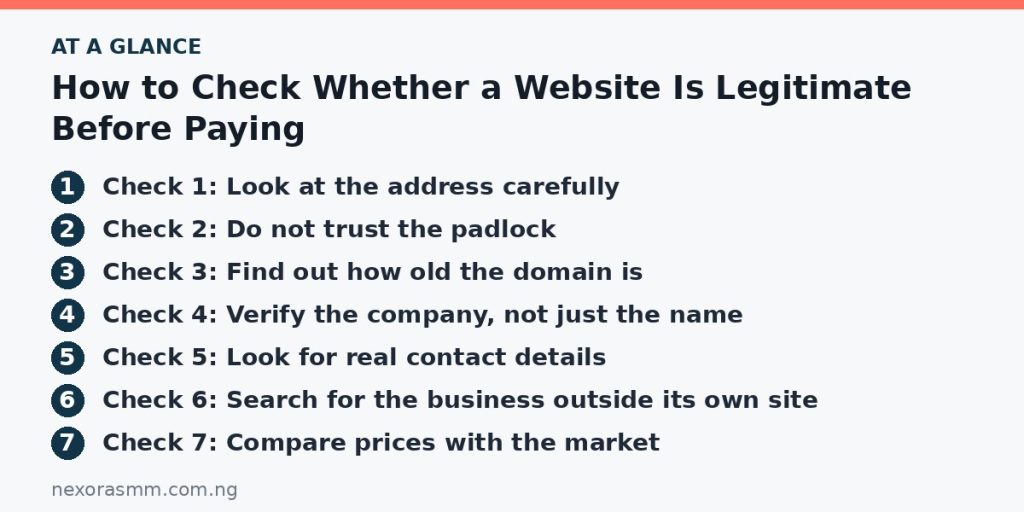
Check 5: Look for real contact details
A genuine business gives a physical address, a working phone number and a professional email on its own domain. Call the number. Check the address on a map and see whether it is a real shop or just a residential plot or empty lot. If the only contact option is a chat widget or a messaging app, be careful.
Check 6: Search for the business outside its own site
Search the business name with words like “scam”, “review” and “complaint”. Read reviews on independent platforms and social media, not testimonials on the shop’s own page. Be careful with a perfect score and a wall of similar reviews posted on the same days.
Check 7: Compare prices with the market
Prices far below the normal market price, particularly for phones, laptops and generators, are a classic lure. Genuine sellers cannot sell far below their cost for long.
Check 8: Reverse-search the photos
Scam shops copy photos from real stores. Search the image with a reverse image tool. If the same pictures appear on many unrelated sites with different business names, treat that as a warning.
Check 9: Read the policies
Look for clear delivery times, return and refund rules, and a privacy policy. Copied, vague or missing pages suggest the site was assembled quickly. Check that the policy names the business and a real address.
Check 10: Choose a safer way to pay
- Prefer card payments or checkout systems that offer dispute options, or pay on delivery for physical goods when it is offered and you can inspect the item.
- Be very wary of requests to transfer money to a personal account, to pay by gift card or to send payment screenshots to a messaging app.
- Never pay an “unlocking” or “release” fee to receive goods you already paid for.
Check 11: Start small and keep evidence
If you are unsure, place a small first order. Save screenshots of the product page, the price, the seller details, receipts and every message. Evidence is what your bank and the authorities need if something goes wrong.
Check 12: Notice the pressure
Countdown timers, “only two left” banners and pressure to pay immediately are designed to stop you checking. Real businesses can wait a day.
If you already paid a fake shop
- Contact your bank or card provider straight away and ask whether the payment can be disputed or stopped.
- Stop all contact with the seller and do not send more money for “release” or “customs” fees.
- Keep screenshots, receipts and the web address.
- Report the site to the platform that showed you the advert and to the relevant authorities in your country.
- Change passwords if you entered any login details.
What we could not confirm
- Which exact web address the CAC’s current public search uses, because the Commission operates more than one portal. Reach it through the Commission’s official website.
- Whether a given seller is honest. These checks lower risk but cannot remove it.
Frequently asked questions
Is a social media page enough proof? No. Accounts and followers can be bought, and pages can be created in minutes.
Can a registered company still scam me? Yes. Registration shows legal existence only, so keep using the other checks.
What if the shop has good reviews? Check where the reviews are posted and whether the wording repeats.
Key takeaways
Verify the address, the domain age, the contact details and the company on the official register, read independent reviews, compare prices and pay in a way that gives you recourse. If several checks fail, walk away.
Sources checked
- BusinessDay, “CAC uncovers 15 fake companies, warns Nigerians to avoid dealings with them”
- Entrepreneurs.ng, “Check If a Company is Registered in Nigeria”
- Youverify, “How To Check if a Company is Registered in Nigeria”
Educational content only — not financial advice. Income and savings results vary and are never guaranteed. How we write
Enjoyed this story?
Get the best stories delivered weekly.