How to Spot AI “Get Rich Quick” Scams Before They Cost You

Whenever a new technology becomes popular, scammers follow. Artificial intelligence is no exception. Social media is full of promises: “Earn thousands a day with this AI tool,” “Let a bot trade for you,” “Copy my AI system and quit your job.” Some are exaggeration; many are outright fraud. This guide explains the most common patterns so you can protect your money and your personal information.
Why AI scams are so convincing
Scammers use words people associate with the future: automation, algorithms, secret systems. They show screenshots of earnings, short videos of “results” and testimonials that are easy to fake. Because many people do not yet understand how these tools work, a confident presentation can seem more credible than it is.
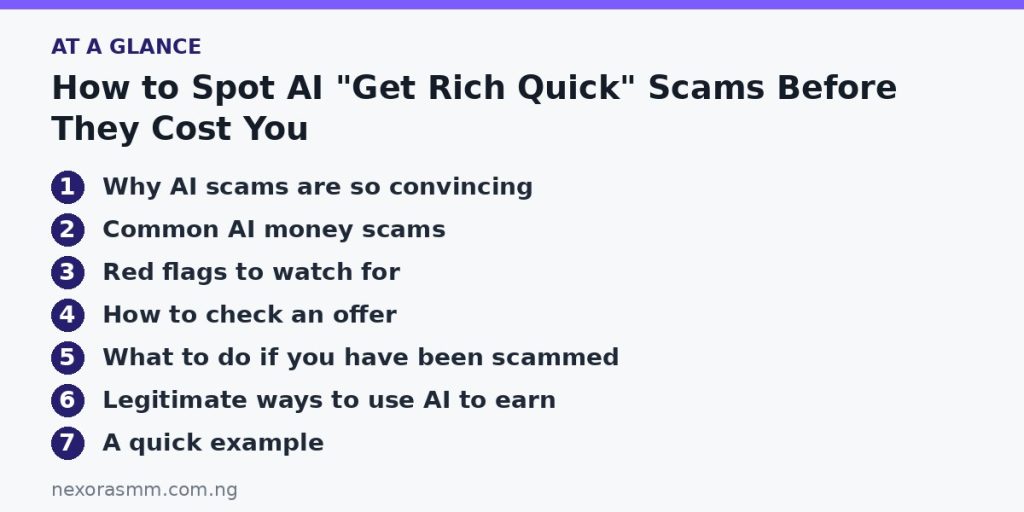
Common AI money scams
Trading bots that “guarantee” profit
No trading system can guarantee profit. Markets are uncertain, and anyone promising fixed or risk-free returns is either mistaken or lying. Be especially wary of anyone who asks you to deposit money on a platform you have never heard of so a “bot” can trade for you.
Courses selling secret systems
Some courses promise to reveal an AI method that makes passive income with no effort. They typically sell a collection of basic prompts at a high price, supported by fake income screenshots and pressure to buy before a countdown ends.
Fake AI tools and apps
Fraudulent sites copy the names and logos of well-known tools, then ask for payment or login details. Others offer “free” downloads that contain malware.
Impersonation and deepfakes
Criminals can imitate voices and faces to pretend to be a relative, boss or celebrity and ask for urgent payment. Always confirm unexpected requests for money through a separate, trusted channel.
Recruitment and “investment” schemes
If your earnings depend mainly on recruiting new members, the structure is likely a pyramid scheme. Money from new participants pays earlier ones until the system collapses.
Red flags to watch for
- Guaranteed returns or “no risk.”
- Pressure to act now, with countdown timers or limited spots.
- Vague explanations of how the money is actually made.
- Payment only by hard-to-trace methods such as gift cards or cryptocurrency transfers to unknown wallets.
- Requests for passwords, verification codes or remote access to your device.
- Testimonials you cannot verify and no real contact details.
- Income claims with no proof beyond screenshots.
How to check an offer
- Search the name of the company or person together with words such as “review,” “complaint” or “scam.”
- Look for a real business address, registration details and a way to reach support.
- Check whether the financial service is registered with the regulator in your country.
- Ask exactly where the money comes from. If the answer is unclear, walk away.
- Talk to a trusted friend or family member before you pay anything.
What to do if you have been scammed
Act quickly. Contact your bank or payment provider to report the transaction, change any passwords you shared, enable two-factor authentication and keep all messages and receipts. Report the scam to the relevant authorities and platforms in your country. Do not be embarrassed: these schemes are designed to fool smart people, and reporting helps protect others.
Legitimate ways to use AI to earn
There are honest ways to benefit from AI: improving your own services, learning skills that employers value, or creating helpful content and products. These routes need effort, take time and do not promise instant results, which is exactly why they can be trusted.
A quick example
Suppose you see an advert showing a smiling person and a message: “My AI bot made me a fortune in a week. Join my private group and I will show you how.” Inside the group, members are told to deposit money on a trading platform “partnered” with the group. After a few small early withdrawals, they are pressed to deposit more. Then withdrawals stop and the organisers disappear. Every step relied on trust, urgency and a platform nobody could verify. Looking for independent reviews and a registered financial licence before depositing anything would have exposed the problem.
Build a habit of pausing
Scammers want you to decide quickly. Make a personal rule: wait at least 24 hours before paying for any online opportunity, and sleep on it. During that time, research the offer, ask questions and read independent opinions. A genuine opportunity will still be there tomorrow.
Frequently asked questions
Are all AI courses scams? No. Some teach useful skills. Judge them by clear syllabus, realistic claims, verifiable instructors and an honest refund policy.
Can a bot really make money for me? Software can automate tasks, but it cannot remove market risk or create value from nothing. Treat promises of effortless profit as a warning.
What if a friend recommends it? Friends can be victims too. Evaluate the offer yourself using the checks above.
How do I protect older relatives? Talk to them about voice-cloning and urgent-payment scams, and agree on a family code word to confirm real emergencies.
Key takeaways
If an offer promises guaranteed money, pressures you to act immediately or cannot explain where the profit comes from, step back. Verify, ask questions and never share passwords or codes. Real income from AI skills grows slowly through useful work, not through secret systems.
Artificial intelligence is making it easier for scammers to imitate people’s voices and create convincing messages. These scams can be especially frightening when criminals pretend to be a family member who urgently needs money. Older relatives may receive a phone call claiming that a child, grandchild or other loved one is in trouble and needs immediate financial assistance.
Protecting older family members starts with awareness, communication and a simple plan for verifying emergencies. Families do not need advanced technical knowledge to reduce the risk of becoming victims.
How AI Voice-Cloning Scams Work
Voice-cloning technology can generate speech that sounds similar to a real person’s voice. Depending on the technology and the audio available, scammers may use recordings taken from public videos, social media posts or other sources to imitate someone.
A scammer might call an older relative pretending to be their grandchild. The caller may claim to have been involved in an accident, been arrested, lost a phone or become stranded somewhere.
The caller then asks for money urgently, sometimes insisting that the relative must not tell anyone else.
Hearing a familiar voice can make the story seem genuine. However, a voice that sounds like a loved one is not sufficient proof of identity.
Agree on a Family Code Word
One practical way to protect relatives is to establish a family code word or phrase that can help confirm an emergency.
Choose a word that is difficult for outsiders to guess and share it privately with trusted family members. Avoid using information that is publicly available, such as a birthday, surname or favourite football team.
If an older relative receives a suspicious call requesting money, they can ask the caller to confirm the agreed phrase.
However, a code word should be treated as one layer of protection, not an absolute guarantee. It could be discovered or shared accidentally, so families should combine it with independent verification.
Always Verify Urgent Requests for Money
Scammers often create panic to prevent victims from thinking clearly. They may demand an immediate bank transfer, mobile payment, gift card or cryptocurrency transaction.
Encourage older relatives to pause before sending money, even when the caller sounds convincing.
They should:
- Hang up and call the family member using a previously saved, trusted number.
- Contact another trusted relative to confirm the story.
- Avoid using a phone number supplied by the suspicious caller.
- Never allow threats or pressure to force an immediate payment.
- Confirm the situation independently before transferring money.
If the supposed family member cannot be reached, contact another trusted person who may be able to establish what has happened.
Teach Older Relatives to Recognise Warning Signs
A scam does not always involve an AI-generated voice. Criminals may use ordinary impersonation calls, hacked accounts, fake messages or edited audio recordings.
Explain that warning signs include:
- A caller demanding money immediately.
- Instructions to keep the emergency secret.
- Requests to send money to an unfamiliar account.
- A caller refusing to answer simple verification questions.
- Claims that there is no time to contact another family member.
A genuine emergency can also be urgent, so these signs do not automatically prove that a call is fraudulent. They indicate that the request should be checked independently.
Reduce the Information Scammers Can Use
Public information can help criminals create more convincing impersonation attempts. Families should review what they share online, particularly information that reveals relationships, travel plans, daily routines or personal contact details.
Older relatives can also benefit from keeping their social media privacy settings appropriately restricted, using strong passwords and enabling two-factor authentication where available.
Be cautious about unexpected voice messages, video calls and links from unknown accounts. Even familiar accounts can be compromised.
What to Do If a Relative Has Already Sent Money
If someone has transferred money in response to a suspected scam, act quickly.
Contact the bank or payment provider immediately and explain that the transaction may be fraudulent. Request assistance with stopping, recalling or tracing the payment, where possible.
Save relevant evidence, including phone numbers, messages, transaction receipts, account details and call records. Report the incident to the appropriate law enforcement or cybercrime reporting authority in your country.
Do not assume that the money can always be recovered, but prompt reporting may improve the chances of limiting further losses. Also, reassure the victim that scammers are skilled at manipulation. Shame can discourage people from reporting what happened.
Conclusion
AI voice-cloning and emergency-payment scams are becoming an important security concern for families. Older relatives can be particularly vulnerable when criminals exploit their love for children and grandchildren or use fear to demand money.
A family code word, independent verification, sensible privacy settings and a rule against rushed payments can help reduce the risk.
The most important lesson is simple: never send money based on a voice alone. When an emergency call arrives, pause, verify the caller through a trusted channel and involve another family member before taking action. A few minutes of verification could prevent a serious financial loss.
Educational content only — not financial advice. Income and savings results vary and are never guaranteed. How we write
Enjoyed this story?
Get the best stories delivered weekly.