How to Create AI Movie Posters
A movie poster is often the first thing an audience sees before deciding whether to watch a film. A well-designed poster can communicate the story’s genre, introduce its main characters, create curiosity, and make a production look more professional.
With AI image generators, filmmakers can create impressive posters for Nollywood dramas, romantic films, horror movies, action thrillers, and historical African stories without hiring a traditional design team for every project.
However, generating a professional movie poster requires more than asking an AI tool to create an attractive image. The characters, background, lighting, composition, and overall mood must work together to represent the film accurately.
In this guide, you will learn how to write effective AI prompts for movie posters, maintain character consistency, and prepare your artwork for publication.
1. Start With the Main Character
The main character should usually be the visual focus of the poster. Their appearance, facial expression, clothing, and position should communicate something important about the story.
For example, a mysterious woman might stand in the center of a psychological thriller poster, while a frightened child could be the focal point of a horror movie.
Before writing your prompt, decide:
- Who is the main character?
- What emotion should appear on their face?
- What clothing or distinctive features should they have?
- Where should they appear in the composition?
If you have already generated character reference images for your film, use them when your image generator supports reference-image input. This can help the poster resemble the characters viewers will see in the actual movie.
2. Add Supporting Characters Carefully
Supporting characters can make a poster more intriguing by suggesting relationships, conflict, or mystery.
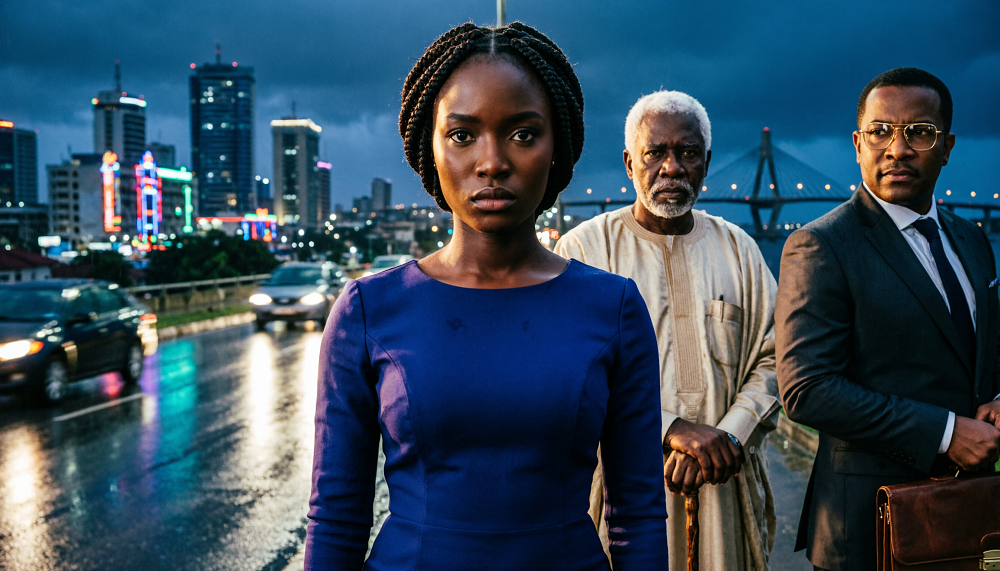
Imagine a Nigerian drama about a young woman caught between an elderly family patriarch and a wealthy businessman. The woman could occupy the foreground, with the older man positioned behind her and the businessman placed on the opposite side.
This arrangement immediately suggests that the characters are connected, even before the audience knows the details of the story.
Avoid overcrowding the poster with too many faces. Three clearly defined characters may create a stronger composition than eight characters competing for attention.
Give each supporting character a distinct position and expression so the audience can distinguish them easily.
3. Choose a Background That Supports the Story
The background should establish the film’s setting without distracting from the main characters.
For a contemporary Nollywood thriller, you might choose a nighttime Lagos skyline, a luxurious mansion, a dimly lit corridor, or a deserted street.
A historical Yoruba film might require a traditional palace, an old kingdom courtyard, or an environment appropriate to the period.
A horror movie could use an abandoned building, a mist-covered forest, or an isolated village road.
Include specific environmental details in your prompt rather than using only phrases such as “beautiful background” or “cinematic environment.”
For example:
“Nighttime Lagos skyline with distant buildings, subtle streetlights, dark atmospheric clouds, and a luxurious modern building partially visible in the background.”
The setting should reinforce the genre and story.
4. Use Lighting and Mood to Create Drama
Lighting determines how the audience emotionally responds to the poster.
Dark shadows and dramatic side lighting can create mystery. Warm golden light can suggest romance, hope, or nostalgia. Cool blue lighting may suit a suspenseful thriller, while vivid colors can help an action film feel energetic.
For a dramatic Nigerian movie poster, consider using strong contrast between the illuminated faces and a darker background.
You can describe the lighting as:
“Professional cinematic lighting, dramatic side illumination, soft highlights on the characters’ faces, deep controlled shadows, realistic skin texture, and atmospheric depth.”
Be careful not to overuse visual effects. Excessive glow, artificial skin smoothing, and unnecessary light flares can make the artwork look less realistic.
5. Write a Complete AI Movie Poster Prompt
A useful poster formula is:
Main Character → Supporting Characters → Location → Mood → Lighting → Composition → Visual Style → Title Placement
Here is a complete example you can adapt.
Example AI movie poster prompt
“Create a premium cinematic Nollywood movie poster for a dramatic mystery film. A mysterious young Nigerian woman stands prominently in the center foreground, with a serious, emotionally intense expression. Behind her on the left is an elderly Nigerian man wearing elegant traditional clothing, his face showing concern and hidden secrets. On the right stands a wealthy Nigerian businessman in a tailored black suit, looking toward the woman with a guarded expression. The background features a modern Lagos city skyline at night, with distant lights and subtle atmospheric haze. Dramatic cinematic lighting, deep shadows, realistic African facial features, natural skin textures, detailed clothing, professional theatrical poster composition, rich visual contrast, photorealistic photography, premium Nollywood movie aesthetic. Keep the main character as the clear focal point, arrange supporting characters at different depths, and leave clean negative space near the top for the movie title. Vertical theatrical poster format.”
This prompt provides the AI with a clear visual hierarchy. It specifies who matters most, where the supporting characters belong, and how the setting should contribute to the atmosphere.
6. Give the Movie Title Enough Space
The movie title is one of the most important parts of the poster. It should be readable at a glance, even when the image appears as a small thumbnail on social media.
However, many AI image generators struggle to produce accurate text. They may misspell a title, create random letters, or distort typography.
A more reliable workflow is to generate the artwork with an empty area reserved for the title, then add the actual text afterward.
You can use Canva, Photoshop, or another graphic design tool to add:
- The exact movie title.
- A short tagline.
- The director’s or production company’s name.
- The release date, if confirmed.
- Credits, where appropriate.
Choose typography that matches the genre. Bold lettering may suit an action thriller, elegant lettering may suit a romantic drama, and distressed lettering may suit a horror film.
Always check spelling and readability before publishing.
7. Maintain a Consistent Visual Style
If you want your poster to represent an AI-generated movie, the characters should resemble the ones in the film itself.
Use the same approved character references, clothing descriptions, hairstyles, and other distinctive features whenever possible.
Also maintain a consistent visual direction. A realistic Nollywood drama may look confusing if its poster uses cartoon characters while the movie itself uses photorealistic visuals.
If the film features several locations or historical periods, choose poster elements that represent the central story rather than attempting to show every scene.
8. Prepare the Poster for Different Platforms
After generating the artwork, review it carefully before publishing.
Check that the faces look natural, the hands and clothing are correctly formed, the supporting characters are positioned properly, and no unwanted objects distract from the design.
Then prepare versions suited to your intended platforms.
- YouTube: Use a composition that remains recognizable when displayed as a small thumbnail.
- Instagram and Facebook: Create versions suited to feed posts and promotional campaigns.
- TikTok and Reels: Consider a vertical design that works well on mobile screens.
- Movie listings and theatrical promotion: Use a vertical poster layout with clear title placement and appropriate credits.
Keep a high-resolution master copy so you can create different versions without repeatedly generating the artwork.
Conclusion
A strong movie poster can make an AI film look more professional and help audiences understand its genre before watching the trailer.
The secret is to combine a clear main character, carefully positioned supporting characters, a relevant setting, dramatic lighting, and a composition that guides the viewer’s attention.
Remember the formula:
Main Character → Supporting Characters → Location → Mood → Lighting → Movie Title → Poster Composition
Generate the artwork first, refine the strongest result, and add accurate typography afterward when necessary. With this workflow, you can create compelling promotional posters for Nollywood dramas, horror films, romantic stories, and other AI-assisted productions.
Educational content only — not financial advice. Income and savings results vary and are never guaranteed. How we write
Enjoyed this story?
Get the best stories delivered weekly.